Marine
Bimini, cockpit cover, camper top: three boat canvases
· 7 min read · Atelier Annie Dallaire
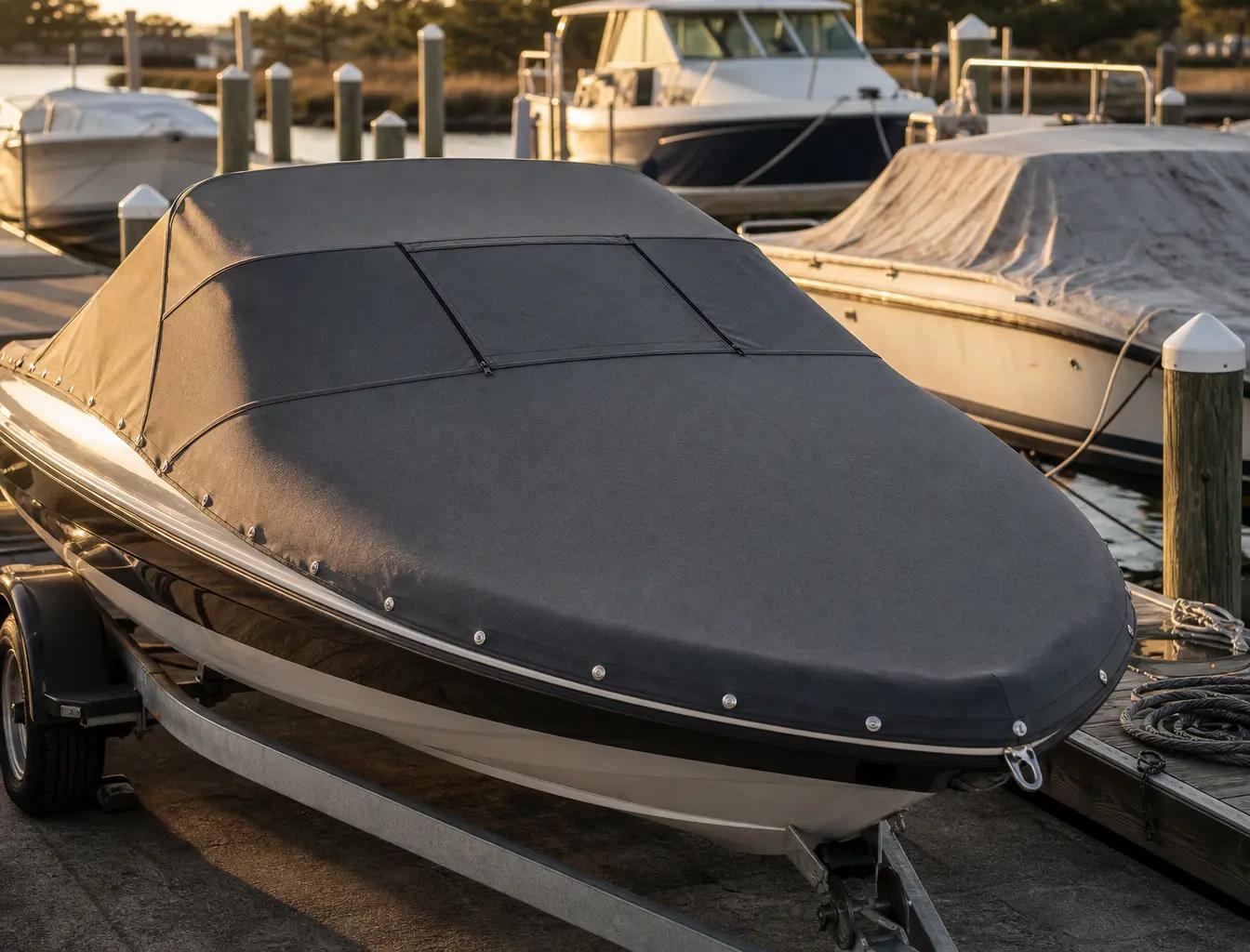
Three words circulate around the marinas of Montreal's Rive-Nord, and nobody bothers to define any of them.
You call about "une toile." At the other end, nobody yet knows whether your boat needs a bimini, a toile rapide or a toit campeur. Those are three different pieces, with three uses, three frames and three budgets. Until the word is settled, a quote means nothing.
Quebec canvas shops sell all three under those names, on their service pages and in their catalogues. None of them explains which one belongs on your boat.
The bimini: shade while you are under way
The bimini is a shade top. Canvas stretched over a folding stainless or aluminium frame, open fore and aft, that deploys and folds down in seconds.
That is its distinguishing trait: it works under way. You move around beneath it, you handle the boat, and it stays put. For your boat that means shade over the helm during the hours the sun hits hardest, without giving up any use of the cockpit.
What it does not do is close anything in. It does not keep rain out of your boat at the dock, it stops neither leaves nor dust, and it does not cover your seats during the week you do not get up to the lake. A bimini alone, on a boat left outdoors, protects the heads of the passengers when there are any. Nothing more.
Toile rapide: covering your cockpit when you are not aboard
The toile rapide is the protective cover. It covers the open areas of your boat, cockpit and open deck, while the boat sits at rest.
Its mechanics are simple, and that is exactly what makes it worth having. It fastens with snaps all around the gunwale, it hooks over the top or under the bottom of the windshield depending on the layout, and it rests on support poles. The practical result: it goes on and comes off in a few minutes, so you actually put it on, even on the evening you are in a hurry to get home.
The poles are not an accessory. The Office québécois de la langue française, in its entry for taud de cockpit, notes that the canvas has to be held up by a structure so water cannot collect in a pocket. A cover lying flat holds rain, the pocket gets heavy, and the weight works the seams all summer. Poles shed the water, and your cover comes through the season without deforming.
Then the vocabulary widens: toile d'amarrage, toile de transport, housse de remorquage, taud de cockpit. Those are not perfect synonyms, and that is where it starts costing money.
Replacement-canvas catalogues put it in writing: some mooring covers carry a note saying they are not recommended as transport covers. A cover that sits quietly at your dock does not take the same load on Autoroute 15 heading for the Laurentians. Highway air pulls on every snap, and the fabric beats. Say it at the first call if your boat travels on a trailer. It changes the fabric, the reinforcements and the number of tie-down points, and it spares you a cover that ages in two round trips.
The toit campeur: closing in your boat's seating area
The camper top starts from the bimini and closes it in.
Side curtains go on, plus an aft panel and clear vinyl windows with or without screens. The seating area becomes an enclosed room. What you gain from it is concrete: cool August evenings on the lake, rainy mornings where everyone stays aboard instead of folding back into the car, and a few extra weeks of season at each end of the summer.
Shops distinguish three levels. The semi-campeur closes part of the cockpit. The full camper top covers the whole seating area. The full enclosure goes all the way and finishes with a solid sloped aft panel, or with one large clear window.
What it asks of you is worth saying before the purchase rather than after: this is the piece of your boat with the most zippers and the most clear vinyl on it. Every panel has its slide, every window has its sewn frame. A zipper rinsed free of salt and windows washed with warm water, every fall, keep the whole thing working for years.
The frame: what each canvas needs, and what is already on your boat
This is the question that decides the quote, and almost nobody asks it on the phone.
The bimini has a frame of its own: bows, fittings, tensioning straps. Canvas and frame are two separate line items, and a frame in good condition is worth keeping.
The toile rapide has no frame in the bimini sense. It has support poles and a line of snaps set into your boat's gunwale. Where those snaps are already there and well placed, the new cover seats onto them.
The camper top is built on the bimini frame, with rear bows added. Replacement-canvas catalogues sell the same camper top in two versions, with frames and without. In other words, what is already on your boat decides a good share of the number.
A frame that has taken a knock, or that is no longer square, changes the work too. The canvas is cut to the frame as it actually is, and a panel occasionally needs an adjustment after the first fitting. That is normal, it gets planned for, and it beats a cover cut from a generic pattern that will pull in the wrong places for ten years.
What to check on your boat before asking for a quote
Five minutes aboard, before you dial.
Name the piece. Bimini, toile rapide or toit campeur. Half the quoting work is done.
Make, model and year. Canvas catalogues are filed by model and by year of build, so those three facts place your boat immediately.
The frame. Present or absent, straight or not, and how many bows on the bimini.
The snaps. The ones already set in the gunwale, and what condition they are in.
The use. Dock only, or trailer as well. And whether you want screens in the clear panels.
New canvas, cut on your own boat
Once the right piece is named, the rest follows.
Annie builds the canvas to measure: bimini, toile rapide, toit campeur, boat cover. Measuring happens on board, at your dock or in your driveway, because a canvas cut to the real dimensions of your boat and its frame sits straight and stays taut season after season. Fabric and thread are chosen to suit the project and the use you put it to, so your canvas lasts as long as it should.
Some materials have to be ordered in, and spring is the busiest stretch of the year. A canvas started in the fall is ready for launch.
By-appointment workshop on Montreal's Rive-Nord, travelling to Laval, the Laurentides and Lanaudière. The custom bimini page covers that piece, frame and canvas explained together. For the toile rapide, the camper top and the full boat cover, the custom boat canvas page walks through how a project goes, from measuring to installation. One thing to settle before you dial: the call, the quote and the work all happen in French, so it is worth having the name of your piece ready in that language.
Frequently asked questions
- What is the difference between a toile rapide and a bimini?
- A bimini is a shade top stretched over a folding frame, open fore and aft, built to be used while you are under way. A toile rapide is a protective cover for the boat at rest: it snaps all around the gunwale and rests on support poles. The bimini shades you on board; the toile rapide keeps weather out of the boat when you are not in it.
- Can a toile rapide be used for trailering?
- Not automatically. Replacement-canvas catalogues distinguish a mooring cover from a transport cover, and some mooring covers carry a printed note that they are not recommended for transport. Highway air load pulls on every snap far harder than a windy afternoon at the dock. Say at the first call whether your boat travels on a trailer, because it changes the fabric, the reinforcements and the number of tie-down points.
- Does a camper top fit onto a bimini that is already there?
- A camper top is built from the bimini: it extends the shade top with side curtains, an aft panel and clear vinyl windows, which closes in the seating area. It usually needs rear bows on top of the bimini frame. Catalogues sell the same camper top in two versions, with frames and without, depending on what your boat already carries.