Marine
Custom bimini
Bimini built to fit your boat. Premium canvas, adapted structure, trade-grade finishes.
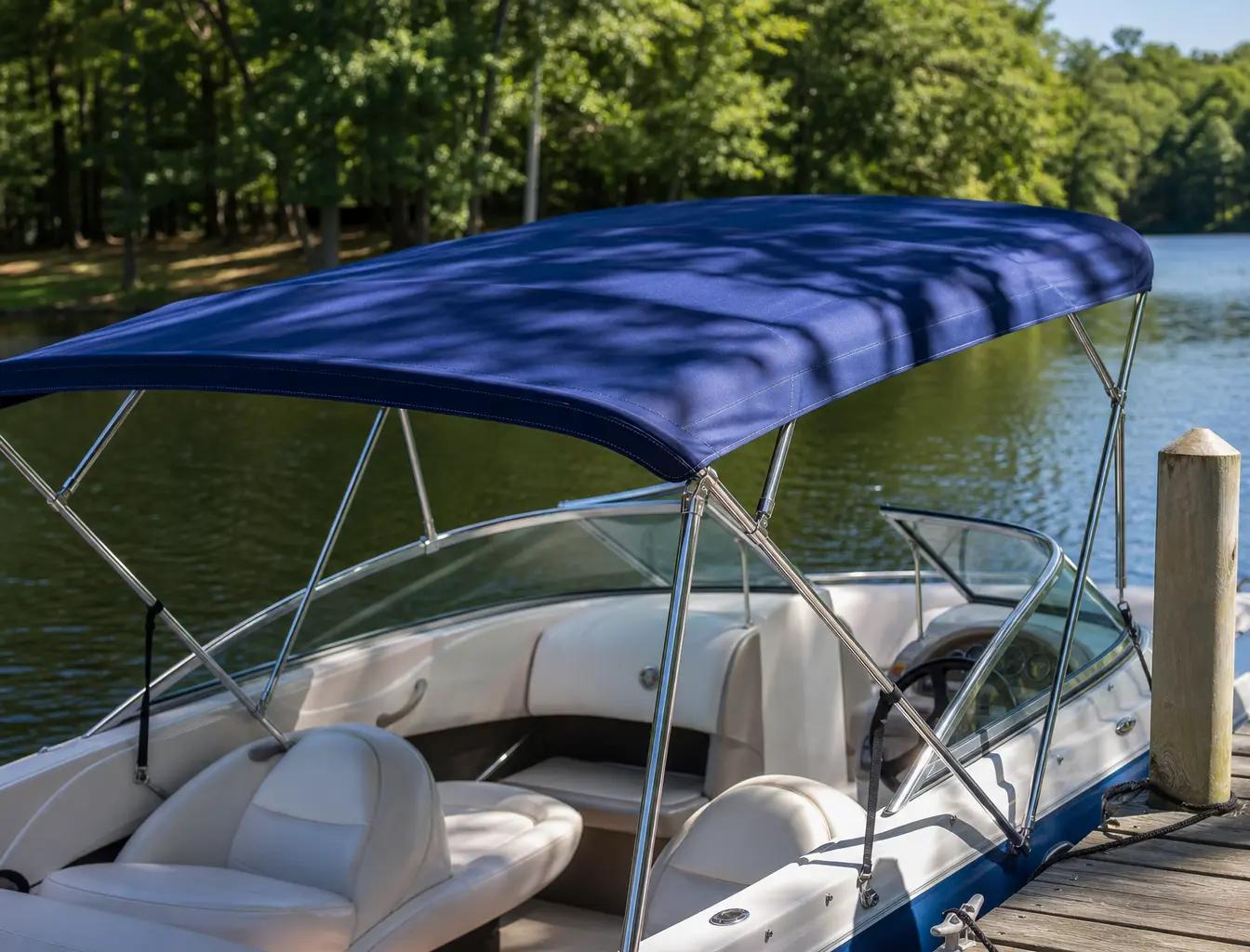
What Annie sews onto your frame
Annie sews the custom canvas for your bimini frame, new or existing. The pattern is taken from the frame in place when the boat or structure can come to the atelier north of Montreal, by appointment, or built from an old canvas you supply as a template. If the frame is new, she works from the precise dimensions of the bows. No standard-template cutting, no catalog.
Several subtypes come through the atelier. The 3-bow and 4-bow bimini cover most requests for bowriders, pontoons and powerboats. The full top adds side curtains and a back drop to the main canvas, closing in the cockpit when the weather turns. A matching convertible top and console cover often join the same project, sewn in the same material so the boat stays visually consistent.
The scope is precise. Annie sews the canvas; the aluminum or stainless frame is not built at the atelier. If the frame is missing or needs replacing, Annie can point you to a supplier. Metalwork isn't her trade, marine sewing is. This page covers the canvas sewn onto your bimini; the wider work on other canvas pieces is covered on the custom boat canvas page.
Every type of boat comes through: sailboat, pontoon, bowrider, cabin cruiser, powerboat. No specialization by model. This is new-build work. Annie doesn't work on old canvas: she uses it as a pattern when a client supplies one, then sews you a new canvas, cut, hemmed, and fastened to your frame. Next: what makes that canvas hold up to sun and rain over the seasons ahead.
Canvas, thread and hardware: what holds up in the sun
A bimini holds up to sun and rain when the canvas, thread and hardware are all marine grade.
The main canvas is a solution-dyed acrylic: the color is built into the fiber before weaving, not applied on the surface afterward. That's the property that lets the canvas hold up to UV rays and salt water without fading or breaking down season after season. Sunbrella canvas is the acrylic reference on the market, and Annie uses it when the project calls for it. Other solution-dyed acrylics of equivalent quality work just as well. Annie works with a network of Quebec suppliers and chooses the material project by project; the brand follows the need, not the other way around.
Thread matters as much as canvas. Annie sews with UV-stable marine polyester thread, built not to break down in the sun. Seams along the edges and tension points are double-stitched, two passes instead of one, which keeps the seam from opening if a single thread breaks. Corners exposed to wind get a separate reinforcement: that's where a bimini gives out first when the stitching is rushed.
Hardware is stainless steel or marine brass. Grommets in brass or stainless, straps mounted on stainless buckles, snaps in brass or stainless depending on the piece, YKK marine zippers or equivalent. No galvanized parts, no bare steel, nothing that rusts from salt or humidity in the first season.
Marine-grade material, double-stitched seams, stainless hardware: that's what makes a bimini last. Next: what happens when you call the atelier for yours.
Quote to delivery: how it works
Five steps, in the same order every time: first contact, pattern, quote, manufacturing, installation or delivery. One artisan, from quote to delivery. Annie runs every project start to finish, with no handoffs and no subcontracted sewing. To learn more about her background, see About Annie.
- First contact. by phone or email. Annie listens, then asks two or three targeted questions: boat type, frame dimensions, subtype wanted (bimini alone, full top, matching convertible top).
- Pattern. Either taken from the frame in place (atelier north of Montreal, by appointment, or a visit within the service area when the boat can't travel), or built from an old canvas you supply as a template, or calculated from the precise dimensions of a new frame when one is provided.
- Quote. written and priced per project: canvas, thread, hardware, manufacturing, delivery. You receive it by email.
- Manufacturing. at the atelier. Pattern, cutting, sewing, finishing and quality control all pass through the same hands, in the same Rive-Nord atelier.
- Installation or delivery. Installed on the boat when it's accessible, or the finished canvas delivered to you, with a fitting and adjustment if needed.
After installation, Annie stays reachable through the first season, to adjust a fastening or answer a maintenance question. On the calendar, spring is peak season. Calling early in winter secures a spot in production before launch.
That's how it works. Next: who calls the atelier, and from where.
Who Annie works for: area and clients
Annie covers boats for individual owners and works as a subcontractor for marinas and restoration shops. Individuals and B2B, both profiles have a place at the atelier.
The service area covers north of Montreal (where the atelier is based), Laval, Saint-Laurent, Laurentides and Lanaudière. Most of the boats Annie covers sail on Lac des Deux Montagnes, Lac Saint-Louis, the St. Lawrence River, or the Laurentides lakes. For a project outside the zone, up to about 2.5 hours' drive.
On the individual side, that means owners of sailboats, powerboats, pontoons, bowriders, cabin cruisers. Every type of boat is welcome. Annie doesn't position herself as a specialist in one model: she sews the canvas to the pattern of your frame, whatever hull is underneath.
On the B2B side, Annie regularly works as a subcontractor for marinas and restoration shops. A season's batch of biminis, canvas to redo across several boats, a one-off piece when the in-house schedule overflows: a call, a quote, and the work gets done. You keep the client, Annie does the sewing. Many marinas in Rive-Nord and Laurentides work with her this way.
The atelier also works in classic auto. In the morning, a bimini on the bench. In the afternoon, a Mustang leather seat under the needle. For classic car interior restoration, it's the same artisan, the same atelier, the same pattern rigor. Two specialties, one point of contact.
That covers area and clientele. Next: the questions people ask most often before confirming a quote.
Common questions
- How long does it take to get a custom bimini?
- Turnaround depends on the size of the pattern, the material to order, and the season. For a boat launching in May or June, calling early in winter secures a spot in production.
- What's the difference between a custom bimini and a bimini cover?
- The bimini is the sun canvas stretched over the frame during the boating season, mounted above the cockpit or console to give shade. The bimini cover is the protective bag that stores the folded canvas off-season, on board or in storage. Two different pieces, two separate quotes at the atelier.
- Does Annie build the aluminum bimini frame?
- Annie sews the custom canvas; the frame, in aluminum or stainless steel, is not built at the atelier. If the frame is missing or needs replacing, Annie can point the client to a metalwork supplier. The value added at the atelier is marine sewing and canvas cutting, not metalwork.
- How much does a custom bimini cost?
- Every bimini is quoted per project, with no fixed price and no catalog. Four factors set the amount: the frame dimensions, the material chosen (canvas, thread, hardware), the complexity (3-bow, 4-bow, full top), and the finish level.
- Does Annie subcontract for marinas?
- Yes, Annie regularly works as a subcontractor for marinas and boat restoration shops. Four categories come out of the atelier often in this context: biminis, deck canvas, boat covers, cabin upholstery. To open a subcontracting file or request a quote on a batch of boats, call or write to the atelier.
Request a quote for your bimini
Custom bimini, hand-sewn by Annie, atelier by appointment north of Montreal. Marine acrylic canvas, UV-stable polyester thread, stainless hardware.
For a quote, a call or an email is enough. We look at the project, take the pattern, and sew the canvas to your frame.