Marine
Boat canvas lifespan: what wears one out in Quebec
· 6 min read · Atelier Annie Dallaire
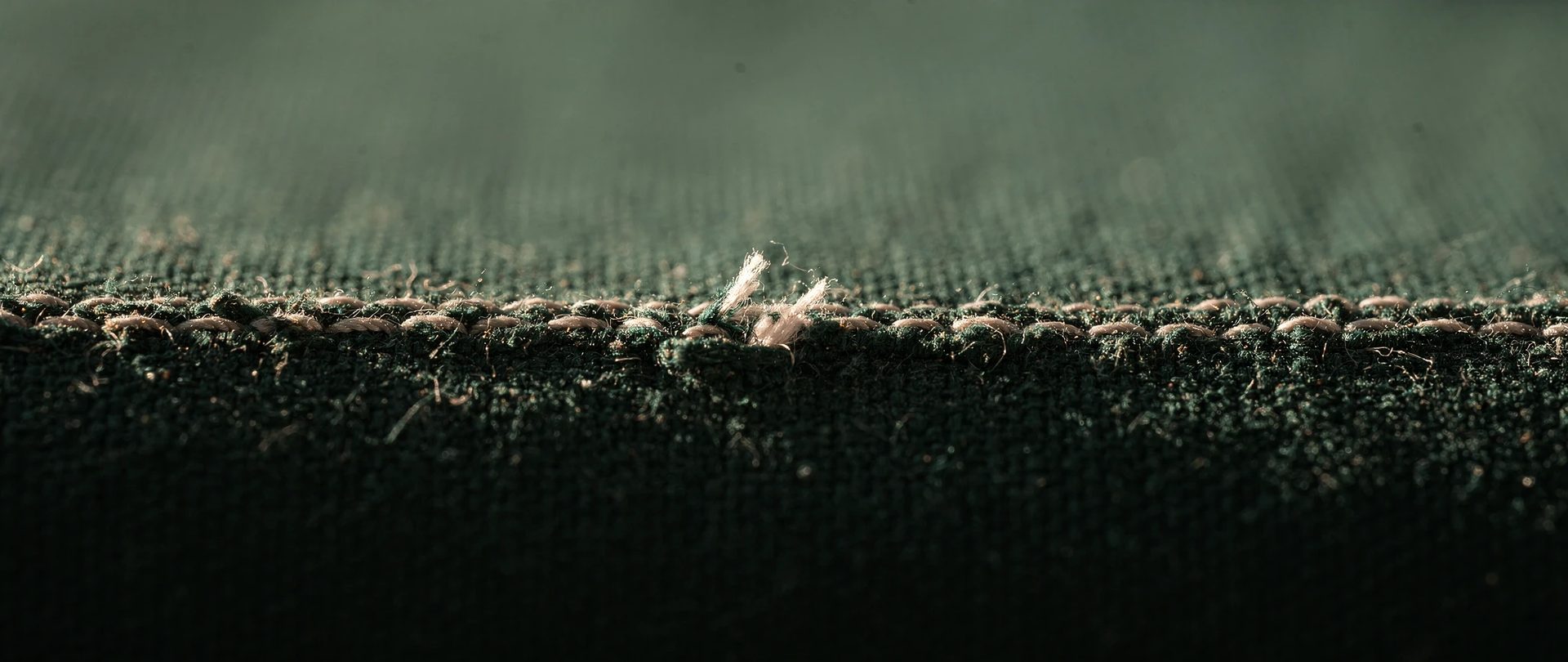
Boat canvas does not give out all at once. It gives out in one specific place, and almost always the same one.
On Montreal's Rive-Nord, your boat is in the water from April to October, then it goes into storage. Six months of sun, six months of storage, and the two halves wear your canvas in different ways. Which is why boat canvas lifespan answers badly in years: two covers the same age, at the same dock, are not at the same stage.
What wears your canvas out in Quebec: UV, freeze-thaw, and water that sits
UV wears out ordinary fabric fast. That is why marine canvas is acrylic: solution-dyed, it carries its pigment inside the fibre, so the colour does not wash out and the fibre keeps its strength. The top panel of your cover holds its shape seasons longer than a polyester equivalent would.
The panel facing the sky goes first; the sides, which only take the sun at an angle, stay good long after. A canvas whose top is flat and tired while the side skirts still look fine is not a neglected canvas. It has put in its hours of sun.
Freeze-thaw works somewhere else. Water gets into the weave and, above all, into the needle holes along the seams: it freezes, it expands, every hole opens a fraction. Over a full Quebec winter that gives you a seam line letting water through before the thread itself has given out, and a canvas left under snow takes that plus the weight.
Then there is water that sits. A slightly slack canvas forms a pocket, the pocket holds water, the weight stretches the cloth, the pocket deepens. The water-repellent finish sheds rain; it does not hold out under a puddle that stays three days. Once water works through, mildew settles into the surface dust, and on solution-dyed acrylic that stain does not come back out.
Boat canvas lifespan: the thread in your seams gives out before the cloth
This is the part the service pages leave out.
Polyester thread, even UV-treated, degrades faster than the acrylic canvas it holds together. The sun breaks it down a little more every season until it loses its strength.
Position makes it worse. A seam stands proud: the thread sits above the weave, takes sun right around its circumference, and abrades every time a panel is handled. So it collects more UV than the cloth around it while being less equipped to take it. Hence the result the whole trade knows: seams open while the fabric around them still looks fine.
PTFE thread changes that equation. It does not rot in the sun the way ordinary thread does. The resistance lives in the material itself and never wears off. Gore, which makes Tenara thread, warranties its own for the life of the fabric it is sewn into. For your boat, that moves the real expiry date: the canvas ends with its cloth.
The thumbnail test. Run a fingernail along a seam on the top panel at the end of the season. If the thread crumbles while the cloth on either side holds, your canvas is finished at its seams. It is the most reliable sign, and the first one.
Your clear vinyl windows yellow before anything else
Clear vinyl windows, the flexible PVC panels Quebec shops call micas, run on their own clock.
Flexible PVC dries out in the sun and heat, season after season. It turns stiff, then hazy, then yellow. A stiff sheet that gets folded splits into a network of fine cracks. That is crazing, and it does not close back up. Ammonia-based glass cleaner speeds the whole thing up. Warm water and a soft cloth keep your windows clear far longer.
The window is mostly a diagnostic: it has taken the same sun as the canvas, but it shows the effect earlier.
The check to run on your canvas before the boat goes into storage
October is the right moment: you are handling everything anyway.
The zippers. Close a run fully, then pull the two panels apart just behind the slider. If it opens up behind the slider, the slider is worn: salt crystallized between the teeth wears it long before the chain.
The windows. Flex a corner at room temperature, never outside in the cold. If it crackles or leaves a white line, it is done.
The seams. The thumbnail test, on the top panel.
Then storage. Wash it, rinse the salt, let it dry through, then roll it for storage. A sharp crease made in cold weather becomes next year's tear.
When a new canvas is the only answer left
There is a point where care changes nothing: the seams on the top panel crumble, the window is crazed, the cloth drinks water and does not bead it. Your boat needs a new canvas.
That is Annie's work: a canvas cut on your own boat, to the dimensions of the hull and its frame. Measuring happens on board, at your dock or in your driveway, because a canvas cut from a generic pattern pulls in the wrong places and ends up digging exactly the water pocket described above. Solution-dyed acrylic canvas or equivalent, thread chosen to hold up to UV as long as the cloth does. Annie picks the material to suit the project, so that your canvas reaches the end of its life in one piece.
Real lead time runs four to eight weeks, and spring is the busiest stretch. Some canvas has to be ordered in, and a panel occasionally needs an adjustment after the first fitting. By-appointment workshop on Montreal's Rive-Nord, travelling to Laval, the Laurentides and Lanaudière.
If your canvas is at that stage, the custom boat canvas page walks through how a project goes, from measuring to installation. The page exists in English so you can read the work before you call; the call itself, the quote and the canvas that follows are in French.
Frequently asked questions
- What is the lifespan of boat canvas in Quebec?
- There is no fixed number: two canvases the same age have not taken the same hours of sun or the same storage. What decides it is the thread. A canvas sewn with polyester opens at its seams while the cloth is still good, whereas one sewn with PTFE thread holds until the cloth is done. Check the seams on the top panel every fall rather than counting years.
- How do I know whether my canvas is finished or good for another season?
- Three signs, checked before storage. The thread on a top-panel seam crumbles under a fingernail. A clear window crackles or leaves a white line when you flex it at room temperature. The cloth drinks water and does not bead it. Two out of three means planning for a new canvas before spring.
Related reading
- Sunbrella fabric or marine vinyl: which goes where
Sunbrella fabric breathes, marine vinyl seals. What ten Quebec summers do to each, and which one belongs on your boat canvas and which on your seats.
- Marine upholstery in Montreal when the shop works in French
Marine upholstery in Montreal is a French-language trade. What a shop actually makes for your boat, how the quote works, and how to deal with one in English.