Materials
Sunbrella fabric or marine vinyl: which goes where
· 7 min read · Atelier Annie Dallaire
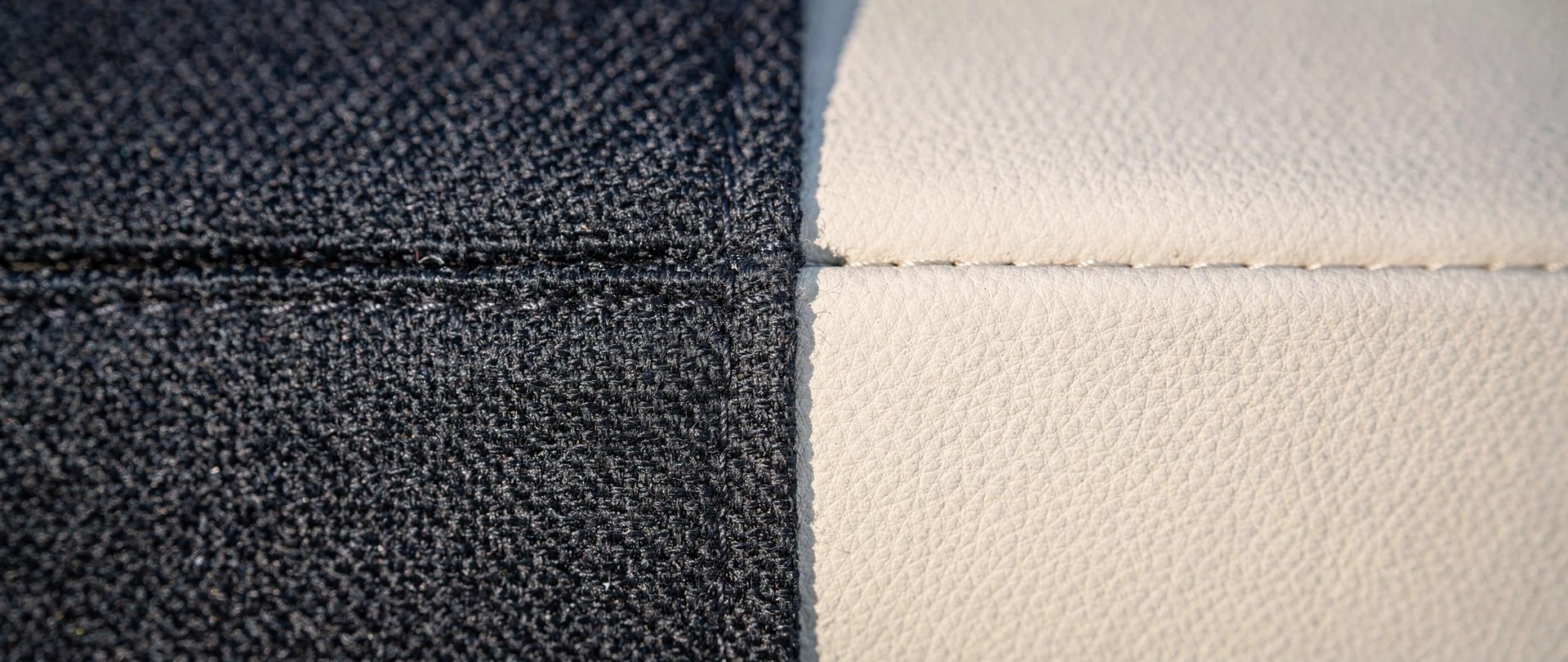
A boat cover and a cockpit bench do not live through the same summer. One dries in the wind in ten minutes. The other stays wet under a towel for four hours.
That is why the choice between Sunbrella fabric and marine vinyl is not settled on price. It is settled by which piece of your boat you are talking about.
Material pages at Quebec marine shops list the two side by side, in the same bullet list, without ever saying which one survives what. Here is the real difference, and what ten summers on the St. Lawrence or on a lake in the Laurentides do to each.
Solution-dyed or surface-coated: what decides the colour of your canvas
Your canvas takes sun twelve hours a day, all summer. What its colour looks like in five years is decided before the cloth is ever woven.
A solution-dyed acrylic takes its pigment in the liquid acrylic, before the fibre is spun. The colour runs right through the filament. That is the construction Glen Raven has used for Sunbrella since 1961, and it is also how several equivalent marine canvases are built.
A canvas dyed after weaving takes its colour on the surface, on a fibre that stays pale inside. UV fades that surface colour first. Abrasion removes a few microns of fibre every season. On a solution-dyed canvas, those microns uncover more coloured fibre. On the other, they uncover the pale core.
What that means for your boat cover: a solution-dyed canvas holds its original tone season after season, while the cloth itself stays sound.
Marine vinyl solves the same problem a different way. It is a PVC plastisol layer over a knitted polyester backing, roughly 0.9 to 1.2 millimetres thick in total. The colour, the UV stabilizers and the anti-mildew agent are compounded into the material during manufacture. So your seats do not lose their tone from the surface either. The pigment is not what ages on vinyl.
Sunbrella fabric for your canvas, marine vinyl for your seats
The rule comes down to one question: does the piece need to breathe, or does someone sit on it.
Your boat gives off moisture all winter under its cover. A bilge that is never quite dry, damp carpet, condensation when the afternoon sun hits the fabric. Acrylic canvas lets that vapour out. A sealed material holds it in, and mildew settles on everything sleeping under the cover.
Your seats have the opposite problem. They take lake water, suntan oil, a wet swimsuit, a spilled drink. There, being sealed is exactly what you want: marine vinyl wipes down with a cloth and dries on the surface, so your cockpit stays clean without the foam underneath drinking the whole season.
Abrasion settles it too. The marine industry puts the threshold for marine vinyl at 30,000 double rubs on the Wyzenbeek method (ASTM D4157). That is the number that matters for a bench someone climbs over a hundred times a weekend.
In practice, on the speedboats around the Rive-Nord and Lanaudière, both materials live on the same boat. Acrylic for the full cover, the tonneau cover, the console cover. Marine vinyl for the cockpit benches, the helm seat, the bow cushions and the swim platform pad.
Freeze and thaw: what your canvas forgives and your vinyl does not
Your two materials fear different things between November and April.
Your acrylic canvas stays supple in the cold. What kills it in winter is the fold. Canvas creased on a hard edge at minus twenty keeps the mark, and that mark becomes the start of a tear the next season. Stored damp, it mildews, and mildew on solution-dyed acrylic never fully comes out. Flat or rolled, somewhere dry and ventilated: that is all it asks in order to come back intact in the spring.
Cold stiffens your vinyl fast. Marine vinyl is specified to a cold crack rating of minus 29 degrees or colder (ASTM D2136), the temperature at which a folded sample splits. Furniture vinyl and automotive vinyl carry no such rating, and they split in a Quebec January.
What eventually takes your seats is not cold on its own. UV and heat dry the vinyl out. It hardens a little more every summer. Hardened vinyl that freezes, then gets crushed by someone sitting on it during the first run in May, splits along the seam line.
That is why the splits always start on the horizontal surfaces, the ones facing the sun, and never on the vertical sides of the same bench. Vinyl specified to the marine threshold buys you seasons before that point.
The thread in your seams gives out before the fabric does
On most of the canvas and benches that come into the workshop, neither the acrylic nor the vinyl went first. It was the stitching.
The reason is mechanical. The cloth of your cover shields everything underneath it from UV. The thread running along the seam has no shield at all: it takes sun on every side, continuously, all season.
Cotton thread gives out in a few seasons. General-purpose polyester lasts somewhat longer, but not in a marine setting. The acceptable floor is a UV-stable marine polyester thread. Above that sit the technical PTFE threads, the Tenara type, for pieces that stay outside the whole boating season.
Annie sews with UV-stable marine polyester and runs the edges and tension points in double thread, two passes, so the seam on your canvas does not open all at once when a single thread breaks. Corners exposed to the wind get a separately sewn reinforcement, because that is where canvas goes first.
That detail also changes how you read your own piece. A seam opening on a canvas with ten summers on it does not mean the cloth was poor. It means the assembly has run its course, and the piece gets made new as a whole.
The material follows your project
Neither one is better in the abstract, and no brand settles the question for you.
Annie works from a network of Quebec suppliers: Sunbrella canvas or an equivalent, marine vinyl, automotive and marine leathers, technical threads. Nothing is fixed in advance. The material is chosen to suit your project, never the reverse.
What goes into that choice: the real exposure of the piece, how many seasons you expect out of it, how your family actually uses the boat, and the budget. A generic acrylic canvas costs less and gives fewer seasons than a well-kept solution-dyed acrylic. On a boat you are selling in three years, that is the right call. On one you keep for fifteen, it is the wrong one.
Real lead time runs four to eight weeks depending on the season. Some colours have to be ordered in and add time, and a fitted piece sometimes needs an adjustment on the following visit. It is patient work, done by hand, in a workshop on Montreal's Rive-Nord, by appointment, with regular trips out to Laval, the Laurentides and Lanaudière to measure on board.
The detail on each family of material lives on the Sunbrella canvas and marine vinyl pages. For the piece itself, the custom boat canvas page walks through how it goes.
For a custom project, request a quote. Write in English if that is easier: the quote that comes back, and the work behind it, happen in French.
Frequently asked questions
- Can Sunbrella fabric be used to cover the seats on my boat?
- Technically yes, and it is not the right choice for an exposed seat. Acrylic canvas lets water and suntan oil through to the foam underneath, which stays damp and eventually smells. For a cockpit bench or a bow cushion, marine vinyl is the material that wipes clean and dries on the surface. Acrylic keeps its advantage on everything that has to breathe: boat covers and tonneau covers.
- How many seasons does a boat cover last in Quebec?
- Two things decide it, well ahead of the brand. First, whether the canvas is solution-dyed or surface-dyed, since that determines whether it fades or holds its tone. Second, whether it is stored dry and without a tight fold, because a frozen crease turns into a tear. The reliable end-of-life signal is not the colour, it is a seam starting to open along the edges.
- Does Annie work only with the Sunbrella brand?
- No. Annie works from a network of Quebec suppliers and picks the material to suit the project: Sunbrella canvas or an equivalent, marine vinyl, automotive and marine leathers, technical threads. On the same boat, the canvas and the seats sometimes come from two different suppliers, because the two pieces are not doing the same job.
Related reading
- Boat canvas lifespan: what wears one out in Quebec
Boat canvas lifespan is not measured in years. UV, freeze-thaw and standing water decide it, and the stitching gives out well before the cloth does.
- Why marine vinyl cracks, and what it says about the foam
Marine vinyl that cracks dried out long before the first split. Once the split is open, the foam underneath decides what happens next.