Materials
Why marine vinyl cracks, and what it says about the foam
· 7 min read · Atelier Annie Dallaire
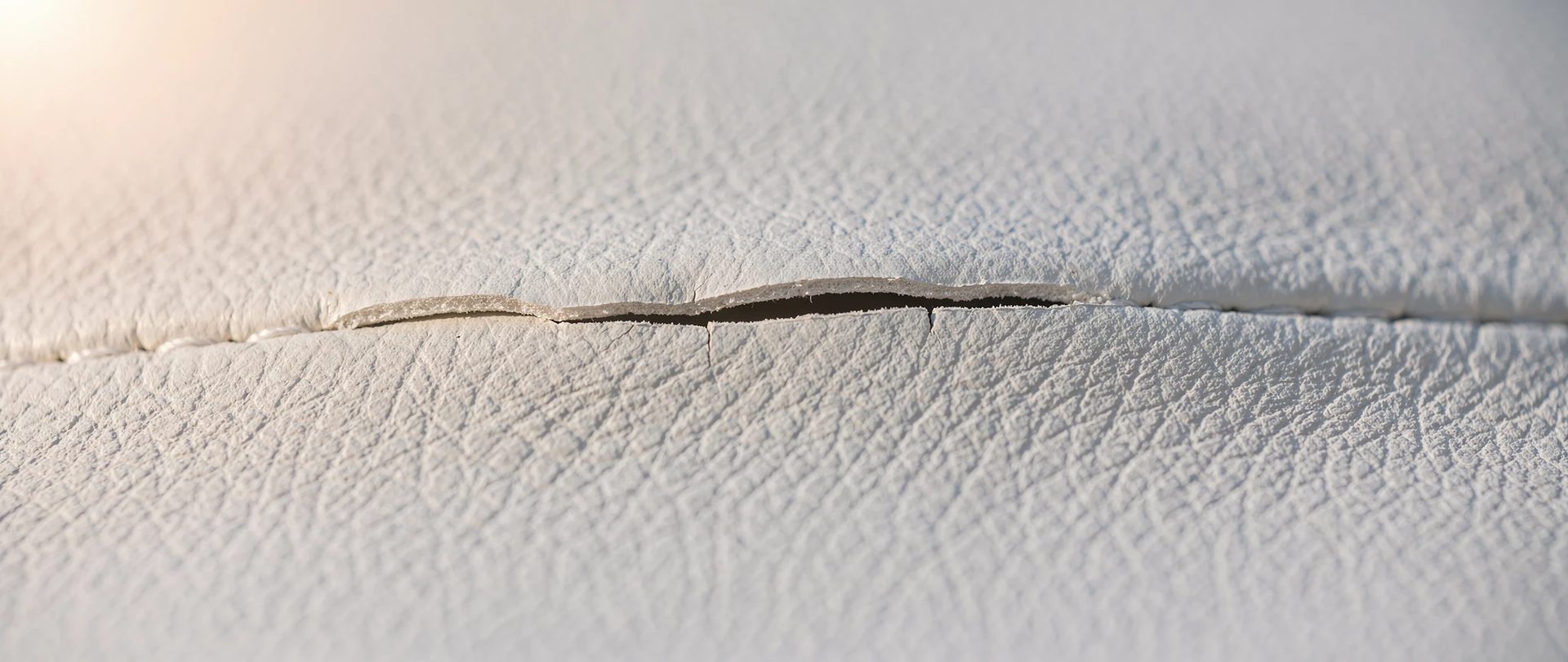
A split in the vinyl of a boat seat is not the start of the problem. It is the middle.
By the time the first crack shows on your helm seat, the marine vinyl has already spent seasons losing what kept it supple. And from that opening on, what happens next no longer happens at the surface. It happens in the foam, and then in the wood underneath.
That is the part nobody explains. Here is the order of things.
On your seat, marine vinyl that cracks started letting go long before
Marine vinyl is a flexible PVC. Sun and heat dry it out a little more every season, and the material gets stiffer as the years go by. What is left behind is a harder PVC that no longer bends the way it used to.
A stiff material does not crack on its own. It cracks under the first load. Someone sits down, someone puts a hand on the bolster to climb aboard, and the split starts there.
That is why cracks always show up in the same places on your seats. The dock-side edge of the cushion, the corner a hand lands on, the top of the backrest that faces south all day. The centre of the cushion, hit less by direct sun when the boat is covered, holds up longer.
Sunscreen works harder on your seats than the sun does
Every marine vinyl maker's care sheet says the same thing: wipe sunscreen off quickly.
Some chemical filters stain the finish and soften it. In the trade, avobenzone is the one most often named, even though manufacturers rarely call it out by name on their sheets. Their instruction, though, is consistent: no strong solvent, no aggressive cleaner, and get the sunscreen off before it dries on.
The surface finish is the layer that takes the UV so the rest does not. Once it softens, the vinyl underneath ages faster. A damp towel run at the end of the day over the spots hands and shoulders touch is the cheapest move you can make, and the one that pushes your seats' deadline out the furthest.
The thread often lets go before the vinyl on your seats
There is one thing owners rarely see coming: the stitching usually goes first.
A seam is exposed on every face, it is thin, and it carries the whole load when someone kneels or stands on a seat. Waxed polyester thread does well in marine use, but it ages under UV. A PTFE thread, the Tenara type, resists sun, salt and cleaners longer than the cloth it holds together.
That choice gets made at the sewing machine. On the seats people stand on, a thread that outlives the cover buys you extra seasons.
Under the split, water runs down into your cushion foam
As long as the cover is closed, the foam in your cushions stays dry. That is the whole job of a cover.
The moment the split opens, water gets through. Ordinary polyurethane foam is open-cell: it soaks up water, it holds it, and it dries very badly once it is sealed under vinyl. A waterlogged cushion stays heavy for days after the rain.
What follows is predictable. Mould settles in, because it has moisture, oxygen and something to feed on. The cell structure fatigues under the wet, compressed, dried cycle. The cushion loses its support, hollows out in the middle, and the smell stops leaving.
This is exactly why a new cover over old foam goes slack within a season or two. The cover is new, the material under it is finished. It keeps giving way beneath the seam, and the vinyl puckers where it should not.
Hydrophobic marine foams exist for this reason. They shed water, for a cushion that stays firm season after season.
And under the foam there is wood: your seat base
On most speedboat seats there is a plywood panel under the foam. It gives the seat its shape and it holds the screws of the pedestal.
The water that came through the cover and the foam ends up there. A panel that has spent seasons damp starts to soften around the fasteners, and a staple driven into soft wood holds nothing. The seat shifts, the cover wrinkles, and the cause is two layers down.
When the base of your seat is at that stage, Annie remakes it in marine plywood rather than covering it. And it is worth being plain about what that buys: marine plywood is not rot-proof wood. APA, the North American engineered wood association, states it without hedging in its guidance. Marine-grade plywood gets no chemical treatment against decay.
What it brings on a seat is void-free plies, a fully waterproof structural adhesive, and a resistance to delamination that ordinary plywood does not have. Sealed and kept dry under a closed cover, it gives you years. Left permanently wet, it will eventually go, like any wood.
A canvas shop or an auto detailer cannot offer you that part. Other Quebec marine shops work in wood too. Having the cover, the foam and the base done in one pass saves you two suppliers and two rounds of measuring.
The wood Annie remakes is the bases and frames of boat seats and benches. Not the joinery in the rest of the boat.
Rebuilding your seat completely: cover, foam and structure
A seat rebuilt as new starts at the structure. A marine plywood base if the old one is done, new foam chosen for the use you actually give the boat, a cover cut to your seat's own dimensions, thread chosen for the exposure it will take.
Measuring happens directly on your boat, at the dock or on the trailer. A pattern taken off an old distorted cover reproduces the distortion.
Real lead time runs four to eight weeks depending on the season. Some materials have to be ordered in, and a specific colour can stretch the wait. It also happens that a seat comes back for an adjustment after installation, once the new foam settles. It is patient work, done by hand, in a workshop on Montreal's Rive-Nord, by appointment. Travel covers Laval, the Laurentides and Lanaudière.
Annie works with a network of suppliers and picks the material to suit the project, so the marine vinyl page describes families of vinyl rather than a single brand. For the rest of the cockpit, the custom boat cushions page walks through the upholstery work, from measuring to installation. An English-reading owner is welcome here, with one thing to plan for: the call, the quote and the work itself happen in French.
Frequently asked questions
- Can a new cover go over the existing foam?
- Yes, but only if the foam is still dry and firm. Foam that took on water through a split has lost its support, and a new cover over it goes slack within a season or two. The test is one gesture: compress the cushion and watch whether it springs back at once. If it stays hollowed or smells musty, the foam gets changed along with the cover.
- How long does marine vinyl last on a boat seat?
- There is no reliable number, because two boats of the same age tied to the same dock do not age at the same rate. Four things make the difference: direct sun exposure, whether the boat is covered between outings, how fast sunscreen and salt get wiped off, and dry winter storage. A south-facing seat left uncovered goes seasons before an identical one kept under a cover.
- Does the wood base need redoing at the same time as the seat?
- Only if it is affected, and that gets checked when the seat comes apart. A panel that softens around the screws or no longer holds a staple is done, and a new cover over it shifts in the first season. A panel that is still firm stays as it is. When it does have to be remade, it is remade in marine plywood, which holds against delamination thanks to its B-grade-or-better plies, free of knotholes, and its waterproof glue.
Related reading
- Remaking a boat cushion: the base under your seat
Remaking a boat cushion without checking the wooden base means tensioning a new cover over a soft panel. It goes slack within a season or two. Here is the test.
- Remaking a boat cabin interior: where the work stops
Remaking a boat cabin interior is never one job. Here are the pieces that belong to an upholstery shop, the ones that go to a woodworker, and where to start.
- Sunbrella fabric or marine vinyl: which goes where
Sunbrella fabric breathes, marine vinyl seals. What ten Quebec summers do to each, and which one belongs on your boat canvas and which on your seats.