Marine
Remaking a boat cabin interior: where the work stops
· 7 min read · Atelier Annie Dallaire
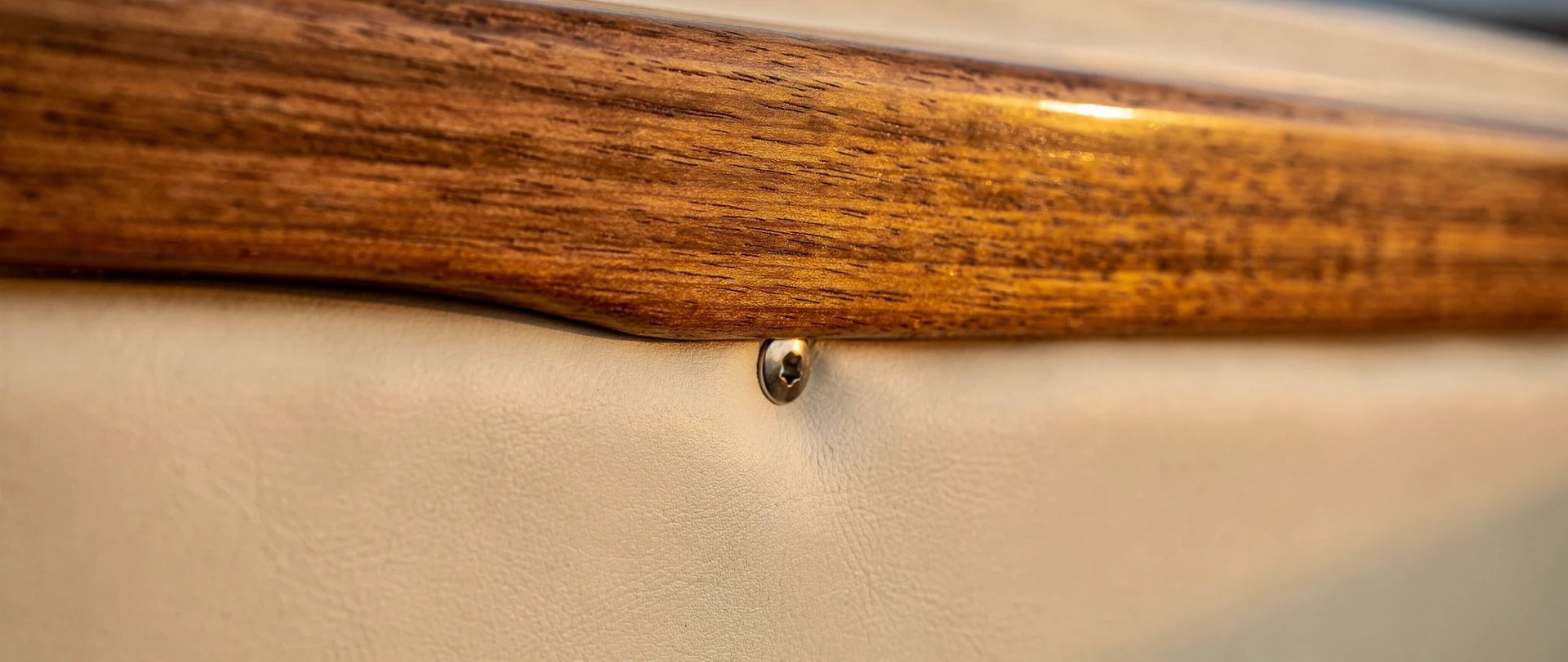
A boat cabin does not age as one piece.
Remaking a boat cabin interior presents itself as a single project. It is almost always four or five separate jobs, sitting on four different substrates, each on its own clock. Your saloon settees, your berth cushions, your backrests, your liner panels and your cockpit benches are not at the same point.
In Quebec your boat runs from April to October. The rest of the year your cabin is closed up, and that half is what decides its condition.
Remaking your boat cabin interior is not one job
What owners call a cabin renovation comes apart into pieces with almost nothing in common.
Your saloon settees sit on a plywood base, like a cockpit bench but out of the sun. Your berth cushions are foam blocks lying flat on a panel, with no air underneath at all. Your backrests are usually mounted on a thin panel screwed to the hull.
Your liner panels and cabin headliner are another family altogether: vinyl or fabric backed with thin foam, glued straight to the hull. And your cockpit benches, just above the companionway, take full sun and lake water.
Five pieces, five ways of reaching the end. That is why a price quoted for "the cabin" rarely survives the first visit aboard.
What six closed months do to the inside of your boat
Your cabin spends the winter as a condensation chamber.
The air stays loaded with moisture: a bilge never quite dry, textiles, mild air on a thaw. The hull follows the outside temperature. It is the coldest surface in the cabin, and any surface that drops below the dew point ends up wet. Practical Sailor measured it on its test boat: surfaces that stayed below the dew point for long enough got wet, and mildew followed.
Where it happens is not where you look. West Marine is direct about it: cushions left flat on their berths trap moisture against the panel and create ideal mold conditions even when the rest of the cabin appears dry. Standing cushions on edge while you are away is, in their words, one of the most effective and most underused measures available.
The fabric is not the food. Glen Raven, which makes Sunbrella, states it in its care sheet: its fabrics do not promote mildew growth, but mildew can grow on dirt and other substances left on them. A clean cushion, stood on edge and ventilated, gets through the winter. A soiled one lying flat does not.
The foam in your cabin cushions does not work like the foam in the cockpit
Outside, water arrives from above. In the cabin, it arrives from below. That changes what belongs inside the cushion.
On a cockpit bench, the reticulated foam the trade calls quick dry lets water pass through. Sailrite, an American marine sewing supplier, describes its open pores as a drainage path: rain goes through and the foam dries in hours, for a bench you can use the next morning.
In the cabin, nothing gets rained on. What your berth cushion takes in is the condensation rising off the hull and staying there for want of air. Ordinary polyurethane foam gives better support for sleeping, but it holds that moisture.
Hence the question to settle before the colour of the fabric: can your foam dry between cycles. West Marine is direct in its mildew guide, once mildew is into the fabric and the foam, putting a new cover on the cushion settles nothing.
Your liner panels and cabin headliner come down for another reason
That one does not go mouldy. It lets go.
Vinyl and fabric glued to the hull are backed with a thin layer of foam. Over the years that foam breaks down. A Practical Sailor reader tells it on his own sailboat: the foam backing on the original white liner had turned to dust, leaving the adhesive alone on the hull. Practical Boat Owner names the trigger: water coming in through deck fittings rots the foam from behind, the glue has nothing left to hold, and the panel drops.
Re-sticking over crumbled foam gives a lumpy result and comes back within the year. What is actually done is simpler, and Practical Boat Owner describes the same sequence: the panel comes down whole and serves as the pattern for the new one, sewn in fresh foam-backed material.
That part, sewing new panels to the exact shapes of your cabin, is upholstery. Scraping the hull and resealing deck fittings is not.
What does not belong to an upholstery shop in your cabin
Better to read it here than find it out during the quote.
The varnish. "Redoing the interior varnish" turns up in the same sentence as "redoing the cabin" nearly every time, and it is not the same trade. Brightwork, handrails and the cabin sole go to a woodworker or a finishing shop.
The joinery. Bulkheads, locker doors, drawers, shelves. The woodwork remade at Annie's workshop stops at the bases and frames of boat seats and benches, in marine plywood, because a new seat on a soft base goes slack within a season. The joinery of the rest of the boat is not part of what she offers.
Curtains and porthole coverings. Not the workshop either.
A shop that announces your cabin "in full" still leaves you a woodworker to find. Knowing that before you plan keeps your boat from sitting between two suppliers in May.
Where to start in your cabin, and in what order
The order matters more than the start date.
Woodwork goes first when it is on the list: sanding, dust, solvents. Anything new installed before that gets dirty and has to be done again. The liner panels and headliner come next, because they need clear access to the hull. Settees, backrests and cushions bring up the rear.
On a sailboat, the headliner and hull panels join the list. On a cabin cruiser, the saloon and the cockpit run into each other.
Measurements are taken on your boat, at your dock or on the trailer, because a saloon settee cut from a generic pattern lands crooked against a bulkhead that never quite is. Travel covers Laval, the Laurentides and Lanaudière, from a workshop on the Rive-Nord de Montréal, by appointment.
The real lead time runs around four weeks before a new project starts. Some materials have to be ordered in, which stretches the wait when you want a specific shade, and a berth cushion does come back now and then for an adjustment once the new foam has settled.
For the cushions themselves, from foam through to cover, the custom boat cushions page walks through how it goes. And if your project runs past the cabin, the marine upholstery page covers seats, benches and the cockpit. You can read all of it in English; the visit to the boat, the quote and the work in your cabin happen in French.
Frequently asked questions
- Does remaking a boat cabin interior include the varnish and the joinery?
- No. An upholstery shop remakes the soft side of the cabin: saloon settees, berth cushions, backrests, panels covered in fabric or vinyl. The varnish, the brightwork, the cabin sole and the joinery belong to a woodworker or a finishing shop. The woodwork remade at Annie's workshop stops at the bases and frames of boat seats and benches, in marine plywood.
- Why do my berth cushions smell musty when the cabin itself looks dry?
- Because the moisture condenses under the cushion, not on top of it. The hull is the coldest surface in the cabin, and a cushion lying flat on its berth holds that moisture against the panel. West Marine describes exactly this as ideal mold conditions even when the rest of the cabin appears dry, and recommends standing cushions on edge during long absences. Mildew does not feed on the fabric itself: it grows on the dirt and residue left on it.
- Does the foam have to be remade at the same time as the covers in a cabin?
- It depends on what the foam has taken in. Foam that has stayed dry and firm can be kept, and it costs you less. Foam that has gone mouldy cannot be cleaned: West Marine is plain about it, once mildew is into the fabric and the foam, putting a new cover on the cushion settles nothing. The test is done by nose, on bare foam, near a corner of the berth.
Related reading
- Remaking a boat cushion: the base under your seat
Remaking a boat cushion without checking the wooden base means tensioning a new cover over a soft panel. It goes slack within a season or two. Here is the test.
- Why marine vinyl cracks, and what it says about the foam
Marine vinyl that cracks dried out long before the first split. Once the split is open, the foam underneath decides what happens next.
- Marine upholstery in Montreal when the shop works in French
Marine upholstery in Montreal is a French-language trade. What a shop actually makes for your boat, how the quote works, and how to deal with one in English.