Skip to content
AtelierAnnie Dallaire

Marine

Custom boat cushions

Cockpit cushions, deck benches, bowrider backrests. Marine foam, marine vinyl, technical stitching, and the wooden base rebuilt from scratch when it has had it.

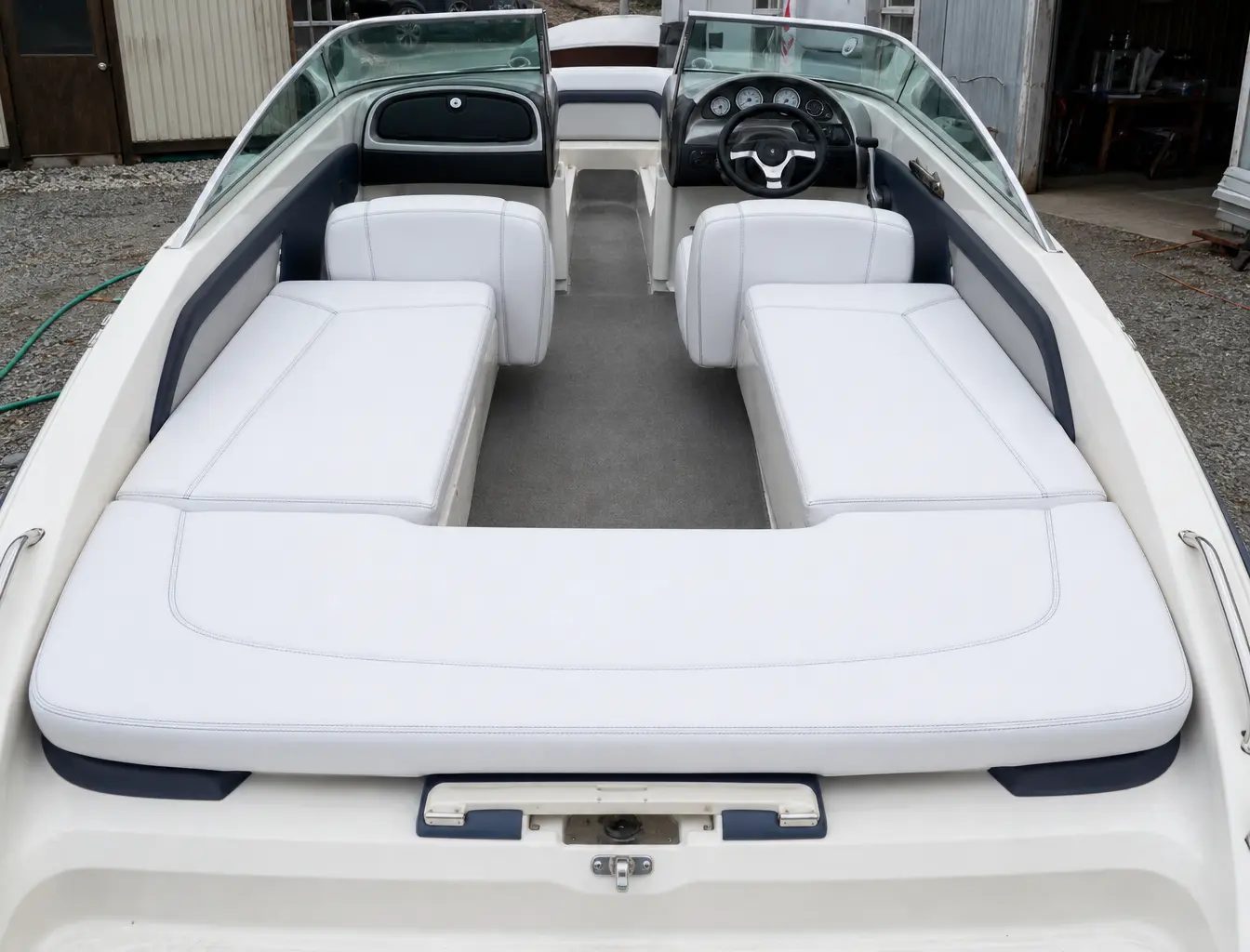
Arctic white marine vinyl cockpit cushions with navy double-stitched seams

What Annie builds for your boat

Annie builds the complete cushion, cover and foam insert, new to new, cut to fit. Many shops rebuild just the cover, or re-foam just the insert on an old cover. Annie does both together, both new. And when the wooden base under the seat has had it, she rebuilds that from scratch too, before mounting the cushion on top. That's the scope.

The pattern is taken one of three ways. Either directly off the bench or existing structure, at the appointment-only shop north of Montreal when the boat can get there, or on-site within the service area when it can't. Or from an old cushion you supply as a template, with dimensions and contour taken off the original piece. Or calculated from the exact dimensions of the base when it's new, including when Annie has just rebuilt it herself. No standard-template cutting, no catalogue.

Several sub-types pass through the shop. The cockpit cushion, the most requested, mostly on the bowriders, outboards, and ski boats that make up most of the speedboat book, exposed to sun and rain, calls for closed-cell foam and a marine cover. The bench cushion covers the deck bench, the interior cabin bench, or the dinette, depending on the boat. The cabin cushion, whether for the V-berth, the cabin salon, or the forward berth, takes softer foams and sometimes a marine leather cover when the space is protected. The swim platform pad calls for high-density foam and outdoor vinyl. The helm seat leaves the shop as a cushion alone or as a complete seat, depending on the project.

Every type of boat comes through: bowrider, outboard, pontoon, sailboat, cabin cruiser. No specialization by model. The broader work on other canvas pieces is covered on the custom boat canvas page; for shade canvas on a frame, see custom bimini.

Next is what makes a boat cushion hold up through sun, rain, and seasons of repeated use: the foam, the cover, the thread, the hardware.

Foam, vinyl, thread: what makes a cushion last

A boat cushion lasts season after season when the foam, the cover, and the thread are all marine-grade.

Foam is the heart of a boat cushion. For outdoor pieces, cockpit, deck bench, swim platform, helm seat, Annie works with closed-cell marine foam. Closed-cell means water doesn't penetrate the material: the cushion dries fast after a rain shower or a wave over the bow, doesn't mildew, and doesn't hold moisture inside the insert. Density is matched to use: high-density for cockpit and helm seat, where the foam has to keep its shape season after season; softer or memory foam for cabin and salon. The insert is cut to final size before the cover goes on, not a standard block trimmed to eye afterward.

The cover is matched to use. Marine vinyl is the workhorse of the cockpit and deck bench. It resists UV, salt, and mildew, cleans with soapy water, and holds up for several seasons in the Quebec climate. Outdoor acrylic canvas, such as Sunbrella canvas or an equivalent solution-dyed acrylic, is the alternative when the client prefers a textile feel and the breathability of acrylic in full sun. Marine leather is reserved for the protected interior cabin: V-berth, salon, dinette, never out in an exposed cockpit. Annie works with a network of Quebec suppliers and chooses the material by project; the brand follows the need, not the other way around.

Thread and hardware matter as much as the foam and the cover. The thread is UV-stable marine polyester, engineered not to break down in the sun. Seams are double-stitched on the edges and stress points, so the seam doesn't open if one thread breaks. Topstitching and piping reinforce the corners. Marine-grade YKK zippers let the cover come off for cleaning without detaching the insert. Snaps, clips, and fasteners are stainless steel or marine brass only. No galvanized parts, no bare steel, nothing that rusts in salt or humidity within the first season.

Marine foam, marine cover, UV polyester thread, stainless hardware: that's what makes a cushion last. One piece remains, underneath all of it, that often decides the rest.

The wooden base under the cushion

Annie also rebuilds the wooden base under the seat. It's the piece most shops don't touch, and it's often the one that decides how long the new cushion will last.

The original plywood in a boat seat sits flat under a cover, exposed to water that gets in through the seams, the screw holes, and the cut edges. After a few seasons, it soaks up water. The wood turns soft, the plies start to separate, and the screws no longer bite when you tighten them. A new cover laid over a base in that state goes slack within a season or two, because what's moving is underneath, not in the cover.

Three signs the base needs rebuilding. The seat flexes or gives under weight. The screws spin freely when you try to tighten them. The wood sounds soft under the hand, or smells damp. When one of these signs shows up, rebuilding the cover alone just pushes the problem back a season.

The base is rebuilt from scratch in marine plywood, to the dimensions taken off the original piece, and the cushion is mounted on it. The cut edges and screw holes are sealed before the cushion goes on. A distinction few people make: marine plywood doesn't resist rot any better than ordinary plywood. Both are bonded with a water-resistant resin. What changes is that marine-grade is tested to spend 72 hours in boiling water without the plies separating, and its core is made without internal voids. Construction-grade plywood allows voids between the plies, and every void holds water. That's why sealing the edges and the screw holes is part of the work, not an option.

That's what rebuilding a seat completely means. The base, the foam, and the cover leave the shop together, cut to your boat. A canvas shop doesn't touch the wood. The work covers seats and benches: helm and passenger seat bases, bench frames, deck cushion bases.

New base, new foam, new cover. Next is how it works when you call the shop for yours.

From quote to delivery: how it works

Five steps, in the same order every time: first contact, pattern, quote, build, install or delivery. Annie runs every project start to finish, with no hand-off and no internal subcontracting on the sewing or the foam work. To learn more about her background, see about Annie.

  1. First contact. by phone or email. Annie listens, then asks two or three targeted questions: type of boat, existing structure (bench, V-berth) or new, cushion sub-type (cockpit, bench, cabin, swim platform), outdoor use or interior cabin.
  2. Pattern. Either taken on-site off the bench or existing structure (appointment-only shop north of Montreal, or on-site within the service area when the boat can't travel), or built from an old cushion you supply as a template (dimensions and contour taken off the original piece), or calculated from the exact dimensions of the structure when it's new.
  3. Quote. written, priced per project: foam, cover, thread, hardware, build, delivery. You get it by email.
  4. Build. at the shop. Pattern, foam cut to final size, cover cutting, sewing, finishing, and quality control all pass through the same hands, in the same north-of-Montreal shop.
  5. Install or delivery. Installed on the boat when it's accessible and within the service area, or the finished set delivered to you, with fitting and adjustment on the bench or structure if needed.

After installation, Annie stays reachable through the first season, to adjust a fastening, answer a question about caring for the vinyl or the foam, or fine-tune a cut. On the calendar, spring is the peak. Calling early in winter secures a spot before the boat goes back in the water.

That's how it works. Next is who calls the shop, and from where.

Who Annie works for: service area and clientele

Annie fits boat cushions for individual owners and subcontracts for marinas and marine restoration shops. Private owners and B2B, both profiles have a place at the shop, on the same cutting table.

The service area covers Rive-Nord (home base), Laval, Saint-Laurent, the Laurentides, and Lanaudière. Most of the boats Annie fits sail on Lake of Two Mountains, Lake Saint-Louis, the St. Lawrence River, or the lakes of the Laurentides. Outside the zone, up to about a 2.5-hour drive, case by case.

On the private side, it's mostly owners of sport boats (bowriders, outboards, runabouts, ski boats); these speedboats dominate the current book. Next come owners of sailboats, pontoons, cabin cruisers. Every type of boat is welcome, with no specialization by model. On bowriders and outboards, it's mostly cockpit and bench cushions that leave the shop, often alongside a new bimini or a boat cover: seats and canvas are the two services speedboat clients ask for together on the same boat. On sailboats and cabin cruisers, it's the cabin cushions that come up again and again.

On the B2B side, Annie regularly subcontracts for marinas and marine restoration shops. Cockpit cushion sets for spring commissioning, cabin rebuilds on resold used boats, a one-off batch when the in-house schedule overflows: a call, a quote, and the work gets done. You keep the client, Annie does the work. Many marinas in Rive-Nord and the Laurentides work with her this way.

The shop also works in classic autos. In the morning, a set of cockpit cushions for a bowrider on the bench. In the afternoon, a Mustang leather seat under the needle. For classic car interior restoration, it's the same artisan, the same shop, the same pattern-cutting rigor. Two specialties, one point of contact.

Common questions

How long does a custom set of boat cushions take?
The timeline depends on the number of pieces, the material to order, and the season. For a boat going back in the water in spring, calling early in winter secures a spot.
Can Annie just re-foam my existing cushions?
No. Annie builds the complete cushion: cover and foam insert, both new, built together. Your existing cushions can serve as a template for the pattern, but what leaves the shop is a new cushion, cover and insert mounted together. It's complete new construction, not a partial fix on the original piece.
Does Annie rebuild the wooden base under the seat?
Yes. Annie rebuilds the wooden base of boat seats and benches in marine plywood, then mounts new foam and a new cover on it. The seat comes back complete, not just recovered.
How do you know the wooden base needs rebuilding?
Three signs: the seat flexes or gives under weight, the screws no longer bite when you tighten them, and the wood sounds soft or smells damp. A new cover laid over a base in that state goes slack within a season or two.
Why marine plywood rather than ordinary plywood?
Both are bonded with a water-resistant resin. The difference is elsewhere: marine plywood is tested to spend 72 hours in boiling water without the plies separating, and its core is made without internal voids. Construction-grade plywood allows voids between the plies, and every void holds water. A distinction few people make: marine plywood resists delamination, not rot. That is why cut edges and screw holes are sealed before the cushion goes on.
Marine vinyl, Sunbrella canvas, or leather: which should I pick for my cushions?
It depends on use and exposure. Marine vinyl is the workhorse for cockpit and deck bench, exposed to UV, salt, and direct water. Outdoor acrylic canvas like Sunbrella is the alternative when the client prefers a textile feel. Marine leather is kept for the protected interior cabin: V-berth, salon, dinette. The material follows the use.
How much does a custom boat cushion cost?
Each set is quoted per project, with no fixed price or catalogue. Four factors: the number of pieces, the material chosen (cover and foam), the complexity (a flat bench versus a contoured cockpit with piping), and the level of finish.
Does Annie subcontract for marinas?
Yes, Annie regularly subcontracts for marinas and marine restoration shops. Spring commissioning, bench sets, one-off jobs when the in-house schedule overflows: a call, a quote, and the work gets done. To open a subcontracting file, call or write to the shop.

Request a quote for your cushions

Custom boat cushions, hand-sewn by Annie, appointment-only shop north of Montreal. Closed-cell marine foam, marine vinyl, UV-stable polyester thread, stainless hardware, and a wooden base rebuilt from scratch in marine plywood when it needs it.

Bowrider, outboard, sailboat, or cabin cruiser: a call or an email is enough. Annie takes the pattern, then builds the new cushion, cover and insert together.