Marine
Remaking a boat cushion: the base under your seat
· 7 min read · Atelier Annie Dallaire
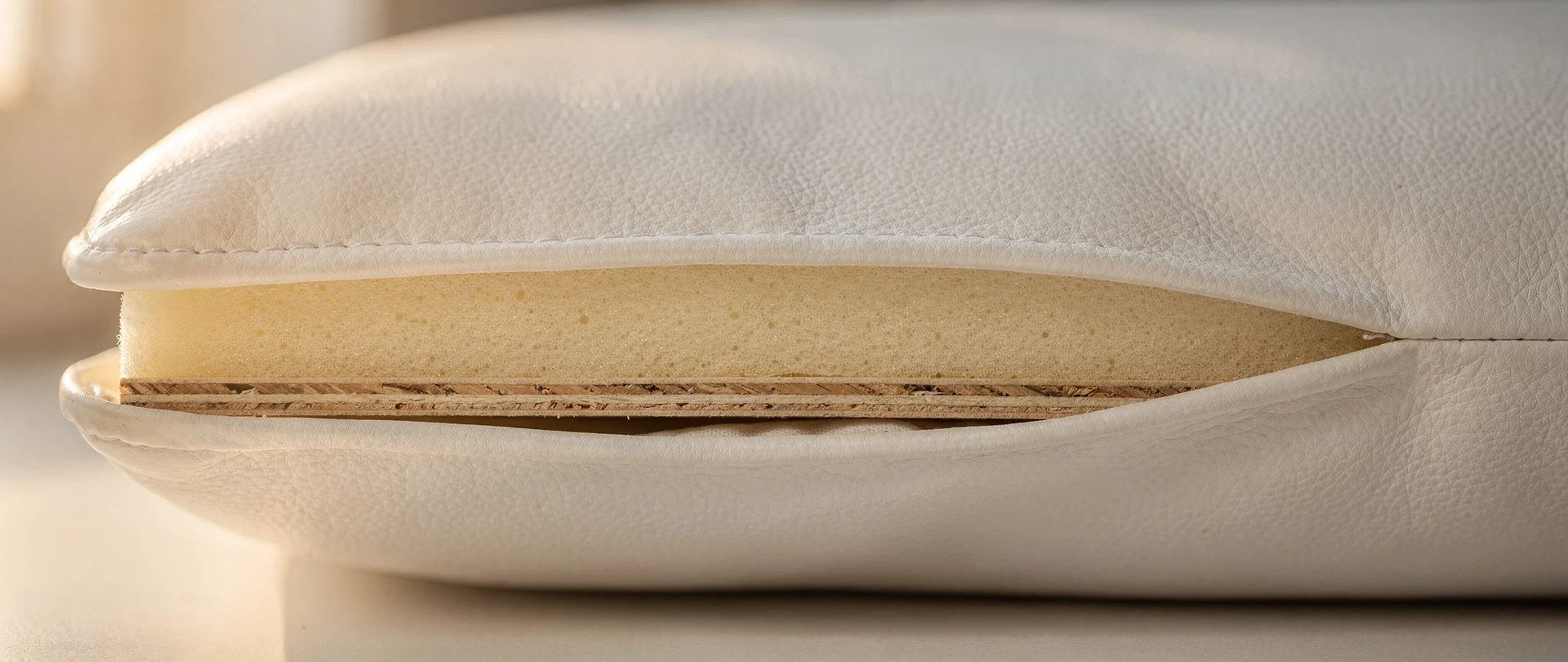
A new cover that wrinkles after one season almost never has a cover problem.
When you are remaking a boat cushion, what decides the outcome is neither the colour of the vinyl nor the density of the foam. It is the condition of the wooden panel under the seat, the one nobody looks at before placing the order.
On your bench, that panel does two jobs. It carries the screws that hold the seat to its pedestal, and it holds the staples that keep the cover under tension. Once it has gone soft, it holds neither.
Here is how to check it on your own boat, before paying for a cover that will not stay tight.
Three signs the base under your seat is finished
The test happens on your boat, in three gestures, with nothing taken apart.
Your seat flexes under load. Press down with your palm at the centre of the cushion, then again near the edge. A sound panel pushes back the same everywhere. A panel that has taken water gives at the centre, or shows one local soft spot, often on the dock side.
The screws no longer bite. Back one screw out of the base and drive it in again. If it spins without ever tightening, the wood around it is spongy. The cover tells the same story: lift a corner and watch whether the staples pull out with no resistance.
The wood sounds dull, or smells damp. Knock the underside of the panel with a knuckle. Dry wood answers sharp and short, waterlogged wood answers dull. And a musty smell under your seat never comes from the vinyl. It comes from the foam or from the wood.
One of those three signs changes the work plan for your seat. Two of them, and a cover on its own would be money spent twice.
Where water gets into your seat, and why it is always the edge
Your cover protects the top face, and it does that job well as long as it stays closed. That is not the way down.
Water comes in at the edges. The panel was cut on a saw, and a cut exposes the edge of the plies, which is where wood drinks fastest. Add the staple holes right around the perimeter, the screw holes underneath, and the fold in the cover that holds a drop of rain.
From that edge, water travels between the plies. The wood swells, dries, swells again. Eventually the glue lets go in places and the plies separate, which is delamination. A delaminated panel keeps its shape at a glance and has already lost its grip.
That is also why the damage on your benches almost always starts in the same place, the perimeter, while the centre still looks fine.
What a soft base does to the new cover on your seat, in one season
On your bench, a cover holds its shape through tension. It is pulled over the foam and fastened all the way around into the wood. With no grip in the wood, there is no tension.
In a spongy panel, the staple sinks without biting. It shifts a little every time someone sits down, then it backs out. Tension drops in the corners first, which is where the cover works hardest.
The rest follows quickly. The vinyl puckers at the angles, the foam shifts under the cover, and the seat starts to move on its pedestal when the boat hits a wake. A season or two, and your new cover looks worn while the material is still good.
That is the outcome the three-sign check spares you.
The base under your seat, remade in marine plywood
When the base under your bench has reached that point, Annie remakes it in marine plywood. The old panel comes out, a new one is cut to its measurements, and the structure of your seat starts over.
A doubled panel holds for a few months and hides the problem under a new cover, where you will no longer watch it progress.
Measurements are taken on your boat, at the dock or on the trailer, because a panel traced from a deformed base reproduces the deformation. The edges of the new panel are sealed before it goes in, so water no longer has the way in that finished the old one.
A canvas shop or an auto detailer cannot offer you that part of the work. Other Quebec marine shops work in wood as well. What it saves you is two suppliers, two sets of measurements and two schedules for a single seat.
The wood Annie remakes is the bases and frames of boat seats and benches. Joinery elsewhere on the boat is not part of what she offers.
What marine plywood gives you, and what it does not
It is worth being plain about what you are buying, because the name promises more than the product delivers.
Marine plywood is not rot-proof wood. APA, the North American engineered wood association, puts it in writing: marine-grade plywood is not treated with any chemicals to improve its resistance to decay.
What it brings under a seat is every ply B-grade or better, so no knotholes, with core gaps capped at one eighth of an inch. Its adhesive is a fully waterproof structural glue, and its exposure rating is EXTERIOR.
Translated onto your bench: the panel takes the wet and dry cycles without its plies separating, and it keeps its grip on screws and staples for years. Sealed and kept dry under a closed cover, it gives you that time. Left wet permanently, it will fail eventually, as any wood does.
Saying otherwise would sell better. It would also be wrong the first time your boat sits uncovered through an October rain.
Remaking your boat cushion in full: base, foam and cover
A seat remade from scratch is built in that order, because each layer depends on the one below it.
The base first, in marine plywood if the old one has reached the end. Then the foam, chosen for the way you actually use the boat, for support that holds season after season. The cover last, cut to the dimensions of your bench.
The real lead time runs around four weeks before a new project starts. Some materials have to be ordered in, which stretches the wait when you want a specific colour. A seat also comes back now and then for an adjustment after installation, once the new foam has settled. This is patient work, done by hand in a workshop on the Rive-Nord de Montréal, by appointment. Travel covers Laval, the Laurentides and Lanaudière.
For the upholstery itself, from measuring through to installation, the custom boat cushions page walks through how it goes. And if your boat needs more than one bench, the marine upholstery page covers the rest of the cockpit. Those pages are in English on purpose; the conversation that follows, the quote and the work on your bench are in French, which is the language Annie works in.
Frequently asked questions
- Can a boat cushion be remade without touching the wooden base?
- Yes, as long as the base is still firm and dry. Check three things before you order: the panel must not flex under your palm, the screws must still tighten, and the wood must neither sound dull nor smell damp. If any one of those signs is there, a new cover fitted over it will go slack within a season or two.
- How do I know the base under my boat seat is finished?
- The test happens on the boat, with nothing taken apart. Press your palm at the centre of the seat and again near the edge: a local soft spot gives away a panel that has taken water. Back a screw out of the base and drive it back in: if it spins without ever tightening, the wood around it is spongy. A musty smell under the seat confirms what the first two checks showed.
- Is marine plywood rot-proof?
- No, and it is worth knowing that before you buy. APA, the North American engineered wood association, states plainly that marine plywood gets no chemical treatment to improve its resistance to decay. Its advantage lies elsewhere: B-grade or better plies and a fully waterproof structural adhesive, which gives it a resistance to delamination that ordinary plywood does not have. Sealed and kept dry under a closed cover, it lasts for years.
Related reading
- Why marine vinyl cracks, and what it says about the foam
Marine vinyl that cracks dried out long before the first split. Once the split is open, the foam underneath decides what happens next.
- Leather embroidery: a club logo on your headrests
Embroidery on leather, marine vinyl or canvas: what actually holds a club logo on your headrests. The decisions that belong in the quote.
- Marine upholstery in Montreal when the shop works in French
Marine upholstery in Montreal is a French-language trade. What a shop actually makes for your boat, how the quote works, and how to deal with one in English.