Marine
Leather embroidery: a club logo on your headrests
· 7 min read · Atelier Annie Dallaire
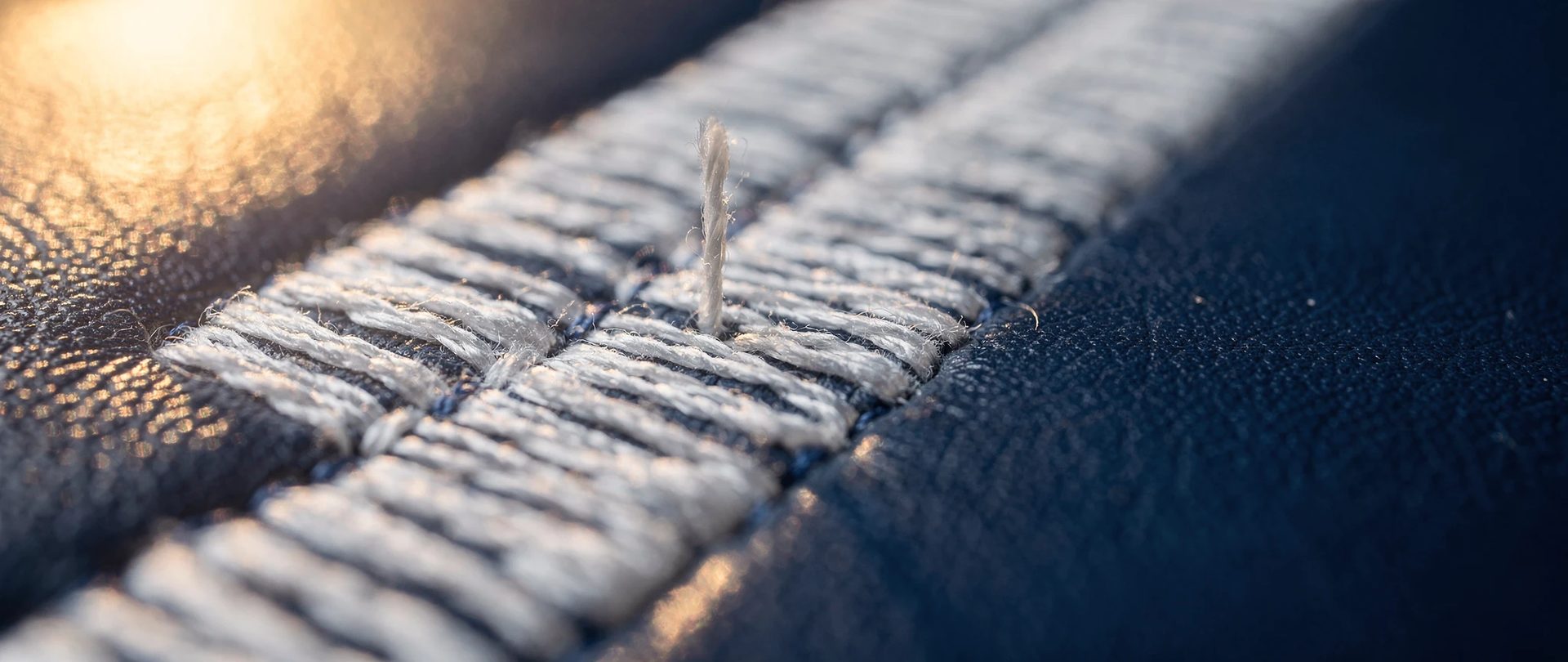
A boating club wants its crest on the headrests across its fleet. A racing team wants its logo on the seat backs. An owner wants the name of his boat on the cockpit cushions.
Three different requests, one shared question: does it hold, and for how long.
Embroidery on leather does not follow the same rules as embroidery on a sweatshirt, and marine vinyl follows others again. Here is what happens to your headrests when the needle goes through, and the decisions that get made before the first piece is cut.
Embroidery on leather: what the needle leaves in your headrests
On a woven fabric, the yarns shift around the needle and the hole partly closes again. Leather does not come back. The perforation stays, and that is the first thing the trade references repeat: the holes do not draw together the way they do in fabric.
What follows is mechanical. Put enough stitches close enough together and you have drawn a perforation line, the same one that runs down a chequebook. The design eventually pulls away and takes the leather with it.
That is why a logo headed for leather is opened up before it is stitched. Professional digitizing guides put numbers on it: satin density moving from 0.4 mm to somewhere between 0.45 and 0.6 mm, fills around 0.6 mm, slightly longer stitches. Fewer holes per inch, so your crest stays part of the leather season after season.
The needle changes too. On leather, the so-called leather needle carries a triangular wedge point that opens a clean slit, in 80/12 for most upholstery weights. On marine vinyl, shops are wary of that same cutting point: it widens the hole in a material that has no fibre to close it, and a fine sharp point does less damage there.
Then there is what happens behind. Leather is embroidered onto a cut-away backing, glued to the reverse, and that backing stays in place after the stitching to hold the material when the seat folds under you. The far less glamorous half of the same job: the hoop marks leather, so strips of cotton go between the two to keep the print off.
Where the design holds on your seats, and where it works
Marine vinyl takes the same permanent perforation. Marine sewing references are blunt about it: every needle hole in vinyl is a potential water entry point to whatever sits underneath.
The consequence reads off your own boat. A vertical surface, headrest, seat back, bolster, does not hold water. The horizontal top of a cockpit cushion keeps a puddle after every storm and takes your weight on top of it.
So an embroidered logo goes on the vertical first. That rules nothing out on a cushion, but it moves the conversation toward the exact placement of the design and toward what sits under the vinyl, the foam and the plywood base.
On an older car the logic is the same minus the water question. The monogram goes on the headrest or the door panel, away from the middle of the seat where it would spend its life under you.
The thread that decides whether your logo sees ten summers
The glossiest embroidery thread on the market is rayon, and it is an indoor thread. Its makers position it for garments, talking about how it holds up in the wash. Industry comparisons are less diplomatic: its dyes break down in light, and a design stitched in rayon and left outside loses its colour well before the piece carrying it does.
The thread that suits your boat is a UV-treated polyester. Several marine thread manufacturers offer it in a size 40 version, the size embroidery uses, presented for monograms that keep their colour outdoors. Same reasoning as canvas: the colour of the logo has to last as long as the piece it is stitched into.
One thread you may know does not apply here. The PTFE used for canvas seams, the one that does not break down in sunlight, is sold as a sewing thread in sewing weights. Its maker does not present it as an embroidery thread and does not take it down to embroidery sizes. For the seams on a canvas it stays unbeaten. For a crest, UV-treated polyester is the right tool.
Club logo, boat name, monogram: the three requests
The club logo is the most structured of the three. The embroidery file is prepared once, and every seat in the fleet then gets the same design, at the same size, in the same place. That is what makes the work worth it for a club, a marina or a restoration shop moving several boats through the same season.
The boat name comes next, usually on the seat backs or on a cockpit cushion. The monogram belongs mostly to the older-car world: two or three letters on the headrest, sometimes repeated on the door panels.
In all three cases the same prerequisite comes up. A logo drawn for print is not an embroidery file. It has to be redrawn stitch by stitch, and that is where fine detail and small lettering get lost, because on leather you cannot tighten the stitches to save them. A club crest often gets simplified a notch to survive the trip.
The other prerequisite is the calendar. Thread in a club's exact colour has to be ordered in, and that runs into weeks before the first piece goes under the needle.
Stitched flat, before assembly: why the order matters
A finished cover is a three-dimensional object. It does not go into an embroidery hoop. So the design lands on the flat panel, before assembly: the backing is hooped, the piece of leather or vinyl sits on top of it, and the embroidery happens there, on a flat surface.
That workshop detail has a direct consequence for you. The decision about the logo belongs to the quote. On seats that are already finished, adding a design means remaking the panels involved from new, with the pattern lifted off your own boat.
For a club that means planning the fleet together. For an owner it simply means naming the logo while colour and material are still on the table.
And as with the rest of the work, a piece sometimes needs an adjustment a few weeks after installation, once you have been out on the water with it. That is part of the job, and the adjustment costs nothing.
The service itself is set out on the embroidery on leather, vinyl and canvas page: monograms, logos, names and decorative designs. The seats, cushions and cockpit side is on the marine upholstery page, and leather interiors on the custom leather seats page.
Clubs, marinas and restoration shops are welcome as subcontract work, one boat or a whole fleet at a time. Measuring happens where the boat is, at your dock or in your garage. Custom upholstery and trim, workshop by appointment, North Shore of Montreal, with travel out to Laval, the Laurentians and Lanaudière. That conversation runs in French, since Annie works in French only.
Frequently asked questions
- Can a logo be embroidered on leather without weakening the seat?
- Yes, as long as the design is opened up. Leather keeps every needle hole permanently, so embroidery that is too dense draws a perforation line that eventually gives way. Professional digitizing guides lower the stitch density and lengthen the stitch for leather, and a cut-away backing glued to the reverse holds the material together during and after the embroidery.
- Will an embroidered logo on a boat seat fade in the sun?
- That comes down to the thread, and only the thread. Rayon thread, the glossiest one, is sold for garments and its dyes break down in light. A UV-treated polyester, offered in the size 40 that embroidery uses, is the thread manufacturers point at for monograms that live outdoors.
- Can a logo be embroidered on seats that are already finished?
- Embroidery happens flat, on the cut panel, before the cover is assembled: a finished three-dimensional cover does not go into an embroidery hoop. On seats that are already done, adding a logo means remaking the panels involved from new. The right moment to settle the design is the quote.
Related reading
- Remaking a boat cushion: the base under your seat
Remaking a boat cushion without checking the wooden base means tensioning a new cover over a soft panel. It goes slack within a season or two. Here is the test.
- Remaking a boat cabin interior: where the work stops
Remaking a boat cabin interior is never one job. Here are the pieces that belong to an upholstery shop, the ones that go to a woodworker, and where to start.
- Marine upholstery in Montreal when the shop works in French
Marine upholstery in Montreal is a French-language trade. What a shop actually makes for your boat, how the quote works, and how to deal with one in English.