Classic cars
Recovering a classic car dashboard
· 8 min read · Atelier Annie Dallaire
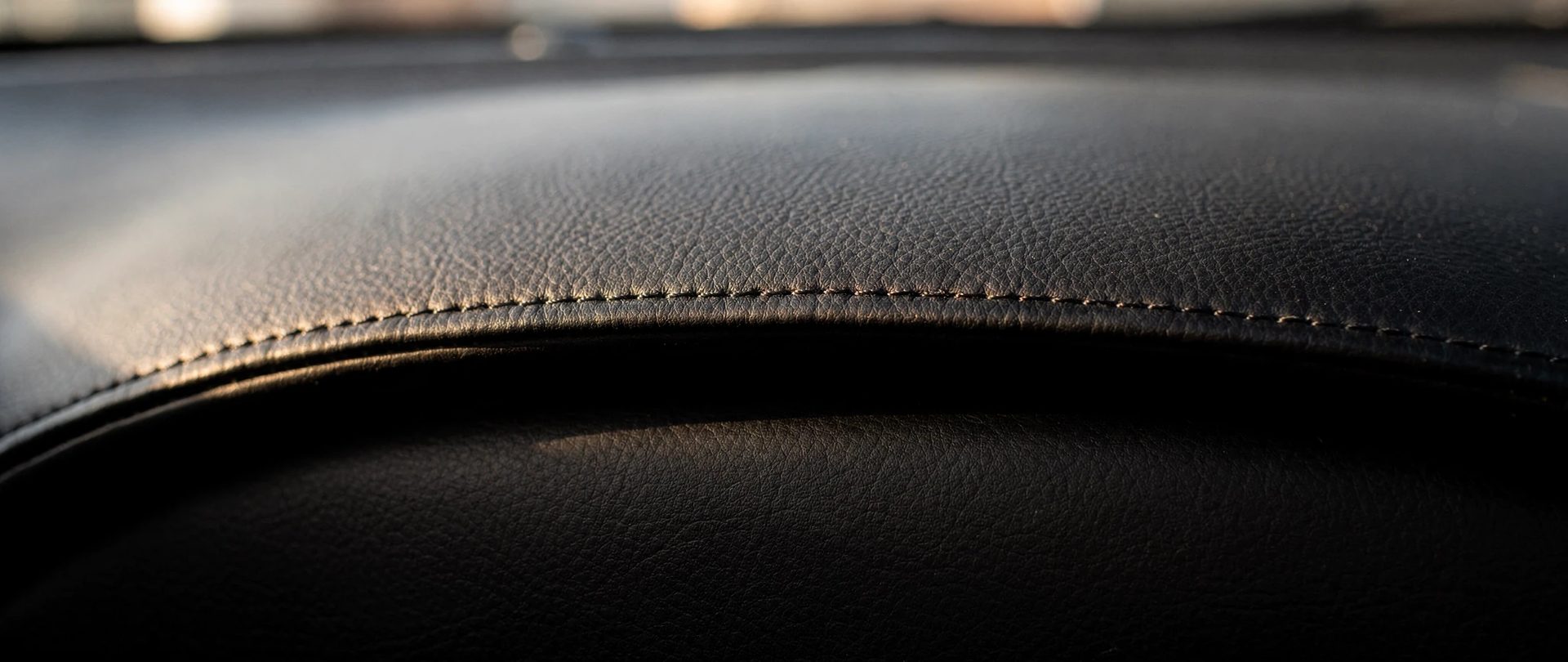
The top of your dashboard has split. One line first, then two, then vinyl lifting on either side of the crack.
Or there is a hole where somebody fitted a radio in the eighties, and another where a gauge came out and never went back.
You have looked at the glue-on caps and the dash mats, and decided that is not what you want. What you are after is recovering the dashboard properly, in real material.
Here is what is happening under that split surface, and what decides the work on your car.
What splits the top of your dashboard
Dashboard vinyl dries out and hardens over time. Heat and UV attack the surface, and the hot-cold cycling of a Quebec parking lot works on both. The vinyl shrinks, it hardens, and it loses its ability to stretch.
Meanwhile the rigid structure underneath barely moves at all.
That is where the split starts. A skin that no longer stretches is sitting over a core that holds its dimensions, and the skin is what gives. Almost always on the top face, the one taking sun through the windshield all day.
Once the split is open, the foam underneath is exposed. It was never meant to be. It crumbles, it turns to dust, and the split widens on its own.
Under your dashboard cover: three layers
A padded dashboard on an American car from the fifties through the seventies is built in three layers.
At the bottom, a rigid structure. Depending on the car and the year, that is sheet metal, fibreglass or a moulded rigid plastic. It carries the shape, the mounting points and the instrument openings.
Over it, polyurethane foam. That is what gives the padded feel under your hand.
And on the surface, the vinyl skin, with its grain and its shade.
At the factory, on many models, the skin was laid into a mould and the foam injected between it and the structure. The three layers are one piece, which is why nobody simply lifts the vinyl to look underneath.
There is still a check you can do right now with nothing taken apart. Press your thumb on the top, right beside the split. If it goes soft and does not come back, the foam is finished. If it stays firm all over and only the surface is open, the foam is probably still holding.
The cap, the mat, and why your dashboard ends up back where it started
Two products get sold for this problem.
A cap is a moulded piece that glues over the dashboard already in the car. A dash mat is a piece of carpet cut to the shape and laid on top.
Both do the same thing. They sit on what is there. The split stays underneath, and the foam that is crumbling keeps crumbling underneath.
There is a question of line as well. A cap follows its own profile. On an original piece with sharp edges and a brow over the gauges, the offset shows at the seam, and it shows most from the side, from the passenger seat.
That does not make it a bad product. It simply covers what's there, without touching what's underneath. If you have got as far as looking up how to recover a dashboard, it is usually because you have already seen one on somebody else's car.
Recovering your dashboard: what happens once the piece is out
The material has to wrap over the edges of the dashboard and be secured on the back of the piece. That is why the dashboard comes out of the car before anything else is touched. Material stopped flush at the visible edge lets go at that edge, and it does it quickly.
The old skin and the dead foam come off first. It is the least impressive step in the whole project, and it is the one that decides the result: until the structure is bare, nobody can see what condition it is in.
Then comes the question the trade settles piece by piece. Do you rebuild on the original structure, or start from a new backing cut to the shape?
Shop practice answers it by the state of the core. A sound structure holds the exact profile of your car, its mounting points are where they belong and its openings fall where the gauges expect them, so it stays. A warped, rusted, cracked or delaminated structure no longer gives that profile back, and a piece built on it inherits the fault, in the hollows as much as the high spots. That one gets a new backing.
It is not a decision anyone makes from a photograph. It gets made on your car, with the piece out and stripped, once the core is visible.
New foam then goes on to the shape, and the skin is cut to the pattern of the piece and stretched by hand, section by section. A dashboard does not forgive a crease in a tight radius. The crease stays, and it catches the light every time the sun drops.
What goes over your dashboard: leather, vinyl or suede
The top of a dashboard is the most exposed surface in your cabin. More than the seats, more than the door panels. So what you would choose for a seat is not chosen the same way here.
Automotive vinyl stays closest to the factory finish on most American cars of that era. It comes in a range of grains, which lets you stay faithful to the original grain and keep the cabin consistent from one piece to the next.
Leather goes on a dashboard too, usually on projects where the whole interior is going to leather and continuity of material matters more than factory accuracy. The detail on the material and how it behaves is on the leather page.
Suede-type cloth, which catalogues often call alcantara after a brand, goes mostly on competition and rally dashboards. The reason is not decorative. A matte surface does not throw the windshield back into your line of sight when the sun is low, and on a car you take out early in the morning or late in the day, that changes what you see of the road.
One note on vocabulary, because it comes up in searches. Skaï is a French brand name that passed into everyday use in France. In Quebec the same material is vinyle, or cuirette.
What your interior becomes once the dashboard is remade
A dashboard made new changes your cabin more than its surface area suggests. It is the piece in front of your eyes the whole time you drive, and it sets the tone for everything else.
That is also why the dashboard, the door panels and the console get worked together when the project allows it. Same grain, same shade, same thread. Otherwise the cabin reads in pieces and the eye catches on whichever one was just remade. Annie works on any classic model, faithful to the original or custom to your own vision.
The rest is less impressive. The usual wait before a new project starts is four weeks and up, depending on the season. Some grains and some shades have to be ordered in, and a supplier who keeps a material in small quantity sets his own calendar.
Catalogues and shop manuals file the dashboard under interior trim, garniture intérieure in French, which is the term you will run into while hunting for parts. In a Quebec garage the word is trim, and custom rembourrage and trim is what Annie does on your car.
The detail of the work, piece by piece, is on the classic car interior restoration page.
Measuring and patterning happen on your car, in your garage, before a single piece is cut. Custom upholstery and trim, workshop by appointment, Montreal's Rive-Nord, with travel out to Laval, the Laurentides and Lanaudière. The conversation and the work happen in French.
Frequently asked questions
- Does a glue-on dash cap fix a split dashboard?
- It hides it. A cap is a moulded shell that sits over the dashboard already in the car: the split stays underneath, and the foam that is crumbling keeps crumbling underneath. It also follows its own profile, which shows at the seam and shows most from the passenger seat. Recovering the piece properly means taking it out and starting from the structure.
- What material goes on a classic car dashboard?
- Three families. Automotive vinyl, which comes in a range of grains and stays closest to the factory finish on American cars of the fifties through the seventies. Leather, mostly on projects where the whole interior goes to leather and continuity of material matters more than factory accuracy. And suede-type cloth, often called alcantara after a brand, chosen on rally dashboards because a matte surface does not throw the windshield back into your line of sight.
- Does the dashboard have to come out to be recovered?
- In almost every case, yes. The material has to wrap the edges of the piece and be secured on the back, or it lets go at the visible edge. Taking the dashboard out is also the only way to see the condition of the rigid structure under the foam, and that condition is what decides whether the piece is rebuilt on the original core or on a new backing.
Related reading
- 1965-1968 Mustang interior: what to remake, what to buy
A 1965-1968 Mustang interior is unusually well served by the reproduction catalogue. Here is what it covers properly, and the parts worth having made.
- Classic car headliner and door panels
A classic car headliner and its door panels fail differently from the seats. Here is what goes wrong behind each one, and what decides recover against remake.
- Recolour or remake your classic car interior
Dye fixes the colour of a classic car interior, never the fibre underneath. Here is what decides between recolouring a cover and remaking the seat completely.