Classic cars
1965-1968 Mustang interior: what to remake, what to buy
· 7 min read · Atelier Annie Dallaire
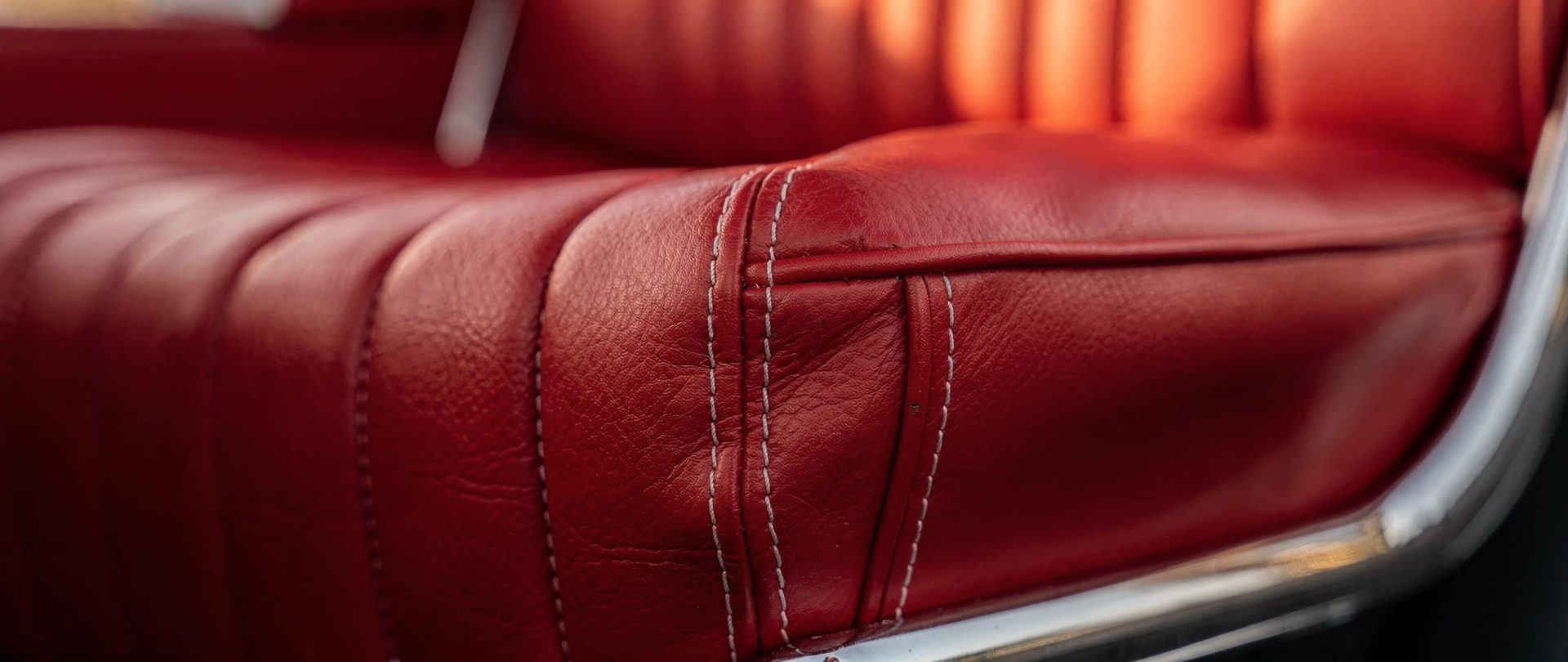
Your 1965-1968 Mustang is one of the few old cars where almost the whole interior can simply be ordered. Carpet, seat covers, door panels, headliner, mouldings, knobs: the reproduction catalogue covers these years better than it covers any other car of the period.
That is good news. It is also what makes the decision less obvious than it looks.
Because the catalogue does not cover every part the same way. Some arrive finished and there is nothing to add. Others arrive half done, and that is where projects come apart.
Here is where the line sits, part by part, on your car.
Your carpet: order it, without hesitating
A reproduction carpet set for a 1965-1968 Mustang arrives heat moulded, formed to the floor pan, with the cutouts already made for the seat rails and the transmission tunnel. It can be ordered in the period colours, with or without jute underneath.
Nobody adds anything to that. A trim shop cannot beat a piece moulded to the exact shape of the floor, and you would gain nothing in either wear or appearance.
The only reservation is about your car. If the floor has been replaced in sections, if new sheet metal has changed the contours, the moulded carpet arrives formed for a floor that no longer quite exists. It then has to be trimmed at fitting, and it shows when that is done badly.
If your floors are original or were replaced cleanly, order the carpet. It is the best value in the project.
Your seats: the kit covers the cover
This is where the line moves.
A reproduction upholstery kit is almost always the cover and nothing else. The foam is ordered separately. The listing wire that holds the pleats in the seat back is not always supplied, and on some years the original foam had none where the new foam does. Owner forums are full of people who find that out with the cover half fitted.
Underneath sits your car's steel frame and springs. They are sixty years old. A back that leans, a cushion that leaves you lower than the passenger seat, a rusted spring: that gets sorted before any sewing, and it is not upholstery work.
Annie says so at the evaluation visit. A new cover takes the shape of whatever is under it, and a flawless cover over a soft cushion goes back to the same hollow within a season or two.
When a seat is remade completely, the cover is cut to the pattern of your own seat, the foam is cut to the density that particular bucket needs, and the two are assembled together for support that holds up season after season. That is the difference between a seat that looks new and a seat that is.
1967 or 1966 Mustang interior: your year decides the part
People do not search for "Mustang interior". They search for their year, and they are right to.
1965 and 1966: low-back bucket seats, crinkle grain vinyl, then the perforated rosette grain that ran for a single year, in 66. This is also the Pony Interior period, with its running horses embossed into the seat back, its moulded door panels with an integral armrest, and its five-dial instrument cluster.
1967: the body grows wider and the interior with it. Seats move to a high back. The dash is redrawn. The deluxe interior still exists, but the embossed horses disappear and are replaced by buttons and stitch detail. The vinyl moves to kiwi grain, which reads closer to leather.
1968: the body and the layout carry over from 67, with the safety additions of the year. A padded steering wheel, energy absorbing door side panels, revised belts.
That matters for two reasons. First, a kit bought for the wrong year does not fit: the 67 seat backs are not the 66 ones. Second, if you want faithful to the original, the pattern, the grain and the pleat count are lifted from your car and not from a catalogue photograph.
Your door panels: when the catalogue answers, and when it does not
Reproduction panels exist for standard and deluxe interiors, in both series.
If your car stays faithful to the factory, this is an order and not a sewing project. The panel arrives in the right shape, in the right vinyl, with the right detail.
The catalogue answers one question well: what did this car look like leaving the factory. It answers no other.
So if you are going to leather, the catalogue leaves you there. Ford never sold leather in those years, so no supplier reproduces a leather 65-68 Mustang door panel: the original part does not exist. A reproduction vinyl panel next to a leather seat set shows immediately, in the grain as much as in the shade.
The same holds for a colour Ford never offered, a stitch pattern that never existed, or a door whose sheet metal has been modified. In those cases the panel is made on the part itself.
Your Mustang's headliner: the material is bought, the fitting is paid for
The reproduction headliner is sold for coupe and fastback alike, in the correct perforated vinyl, often with the insulation. The material is not the problem.
What you pay for is the tension and the bows. A headliner goes onto pre-formed bows that have to be straight, in place, and in the right order. A bent bow or one seated in the wrong slot gives creases that nothing afterwards will take out.
It is the part where good material most often gives a poor result, and it is why it ends up at a trim shop even when everything else was ordered.
What is left to have sewn for your Mustang
The split, in one line. Carpet gets ordered. The headliner gets ordered and fitted. Panels get ordered if you stay faithful to the factory. Seats, and anything that departs from what Ford sold, get made.
Annie does the making: seat covers, foam, panels, headliner, console, armrests, trimmed trunk. Faithful to the original or custom to your vision. The scope by component is set out on the custom Mustang trim page, and classic car interiors in general on the classic car interior restoration page. For the leathers, the grains and the finishes, see automotive and marine leather.
A word on expectations. A made interior does not get settled in a week: real lead time runs about four to eight weeks depending on the season, and some leathers have to be ordered from a supplier who stocks them in small quantity. It also happens that a seat needs an adjustment after a few weeks of use, once the foam has taken its shape. That is part of the work.
And one thing worth stating plainly: Annie is not a Mustang specialist. She works on any classic car model, faithful to the original or custom to your vision. Mustangs come through often simply because there are a lot of them on the road.
Measuring happens in your garage, on your car, before a single piece is cut. Custom upholstery and trim, workshop by appointment, Montreal's Rive-Nord, with travel out to Laval, the Laurentides and Lanaudière. That visit runs in French, like the quote and everything after it, so an owner who reads this in English and speaks French is on the right page.
Frequently asked questions
- What is the Pony Interior on a 1965-1966 Mustang?
- It is the common name for the Interior Decor Group, the deluxe interior option offered in 1965 and 1966. You recognise it by the running horses embossed into the seat backs, the moulded door panels with an integral armrest and courtesy lights, the five-dial instrument cluster and the woodgrain appliques. The 1967 redesign kept a deluxe interior but dropped the embossed horses, so a 67 or a 68 never had a factory Pony Interior.
- Did Ford offer leather seats on a 1965-1968 Mustang?
- No. The interior codes for those years give vinyl, in crinkle, rosette and then kiwi grain depending on the year. The rare Mustangs delivered in leather came from special orders; the catalogue never listed it. A leather Mustang interior is custom work by definition. It is also why you will never find one as a reproduction kit, from any supplier.
- Does a reproduction upholstery kit include the foam and the seat frame?
- Rarely both, and often neither. Most catalogues sell the cover on its own, the foam is ordered separately, and the listing wire that holds the pleats is not always supplied. The steel frame and the springs are the ones that have been in your car for sixty years and belong to no kit at all.
Related reading
- Recovering a classic car dashboard
Recovering a classic car dashboard is not the same as capping it. What splits the vinyl, what sits under it, and what decides how the piece is rebuilt.
- Leather or fabric for a classic car interior
Leather or fabric for a classic car interior. What each material actually holds up to, piece by piece, and how the choice gets made before anything is cut.
- Recolour or remake your classic car interior
Dye fixes the colour of a classic car interior, never the fibre underneath. Here is what decides between recolouring a cover and remaking the seat completely.