Materials
Leather or fabric for a classic car interior
· 8 min read · Atelier Annie Dallaire
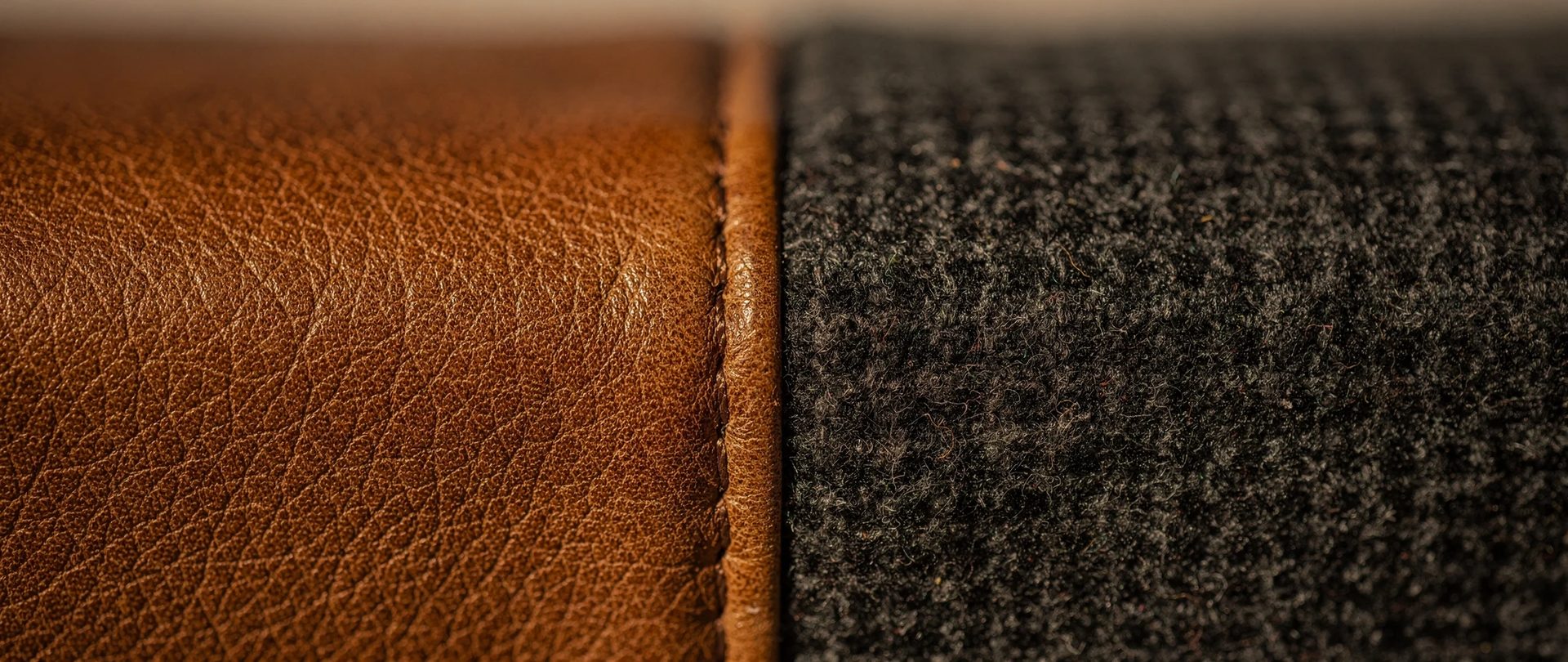
You are remaking the interior of a classic car, and the first question that comes up is not the colour. It is the material.
Leather or fabric: the question is answered all over the web, and almost always for someone ticking an option box on a new car. Resale value, heated seats, image. Your car has not had an option list in fifty years, and nobody is going to buy it on the strength of its leather.
On an interior that gets cut and sewn to a pattern, the question works differently. It gets asked piece by piece, and the right answer is very often a mix.
Leather or fabric: your car does not ask the same thing everywhere
Look at what each piece of your cabin takes.
The seat cushion carries your weight, the friction of every entry and exit, and the humidity of a summer afternoon. The bolster, the one you climb over with the seam of your jeans, takes almost all of the abrasion. The seat back works far less hard.
The door panel takes your elbow, the window sill and the moisture running down the glass. The headliner takes no contact at all. Only heat.
Five pieces, five different demands. One material across all five is a catalogue decision, not a pattern decision.
It is rarely what your car left the factory with either. On North American models of the fifties, sixties and seventies, base trim almost always paired vinyl bolsters with fabric inserts. Full leather was an expensive option, and on several models a rare one. French searches call that combination cuir partiel, partial leather. In a Quebec garage it is simply how your car was assembled.
What fabric does better inside your car
A fabric interior is not the second-choice interior. There are places where it holds the role better, and cars where it is the only right answer.
Fabric breathes. You feel it on a seat cushion in July, in a car parked in the sun with no air conditioning. Fabric does not store heat the way a dark pigmented surface does, and it does not go stiff in the cold. A car that sleeps outside from November to April stays uncomfortable on a leather cushion until the cabin has warmed up.
Fabric is also the exact answer when your project is aiming at original. A full leather interior on a model that never had one reads wrong to anyone who knows the car. If faithfulness matters to you, fabric is the correct choice.
Then there is material yield, which surprises people. Fabric arrives on a roll at constant width and cuts with almost no waste. A hide arrives with an irregular outline, areas that stretch too much for a seat cushion, and life marks to work around. A leather interior therefore needs more square feet than the sum of its panels, and that shows up in the quote. The detail of that calculation is on the automotive and marine leather page.
What leather holds better, and on which pieces
The case for leather in a car is not the feel. It is how it holds its shape.
Automotive leather carries a textile backing bonded to the reverse that keeps it from stretching. That backing is what keeps a door panel flat after years and a topstitch aligned after hundreds of entries and exits. A textile stretched over the same piece works harder and eventually marks where it is loaded most.
On the abrasion areas the gap is just as clear. The bolster you climb over every time, the front edge of the seat cushion, the outer border of the door panel: those are the places where leather buys you the most years.
The leather families, full grain, corrected, aniline, perforated, nappa, and what each one changes on your seat, are the subject of the automotive and marine leather page. The useful point here is simpler: leather is not one category, and two interiors both described as leather can behave very differently after five winters.
Because leather does move over time. Heated indoor air through a Quebec winter is dry, and a dry hide that gets flexed cracks first at the stitch lines. What winter does to each material is set out in leather, vinyl and canvas: what a Quebec winter does to each. Routine care stays on your side, or your detailer's. The workshop builds interiors and remakes them; it does not offer a care service.
Vinyl and Alcantara: the finishes that live in between
Leather or fabric leaves out two materials that cover a good share of older cabins.
Vinyl, called cuirette in Quebec, is probably what your car wore on its bolsters when it left the factory. The France-French word is skaï, the one you will run into on European forums. A good vinyl today differs sharply from the vinyl of 1975: it is opaque, waterproof and UV-finished, and it takes direct exposure without changing hand. The material is described in detail on the marine side, on the marine vinyl page, and the reasoning carries over to a car cabin.
Alcantara comes up constantly in searches, and it is almost always filed wrong. It is neither leather nor suede. It is a microfibre, which makes it a textile.
It does not wipe clean like a pigmented finish, the fibre holds dust and hand oils, and on a bolster climbed over every day in jeans it flattens and burnishes faster than the rest of the cabin. An Alcantara insert with leather borders is a combination that holds. A full Alcantara cabin in a car driven every week, much less so.
How the material gets decided on your car
The choice starts from your car and from how you actually use it.
Four questions settle it nearly every time. Where the car sleeps, garage or outside, soft top or hard roof. How often it comes out, twelve outings a summer or every Saturday. What you are aiming at, faithful to the original or custom to your own vision. And who gets in, because a dog, kids or a wet swimsuit at the end of the day change the answer more than any aesthetic preference does.
Annie works with a network of suppliers and chooses the material to suit the project. No imposed brand, no default hide or default roll. On a full interior, materials of the same shade are ordered from one lot so the colour stays consistent panel to panel.
The word to use when you call a shop
Searching, you probably went through sellerie voiture cuir ou tissu and landed on French shops. The word does not carry over here: in Quebec, sellerie suggests horse tack before it suggests a car. The word used here is rembourrage, and for a car interior, trim.
The materials, family by family, are on the automotive and marine leather page. For the seats themselves, foam included, leather seat creation and refection covers the whole job, and classic car interior restoration covers the panels, the consoles and the headliner.
Measurements and samples happen on your car, in your garage, before a single piece is cut. Custom upholstery and trim, workshop by appointment, Montreal's Rive-Nord, with travel out to Laval, Saint-Laurent, the Laurentides and Lanaudière. The conversation and the work happen in French: 514-298-7735 (French only).
Frequently asked questions
- Leather or fabric for a classic car interior?
- Almost never one or the other for the whole cabin. Bolsters and outer panels, which take the abrasion of every entry and exit, last longer in leather or vinyl. Seat and back inserts do better when they can breathe, and fabric is often the stronger choice there. That is also how most North American cars of the fifties through the seventies were built at the factory.
- Is Alcantara a leather?
- No. It is a microfibre, which makes it a textile, neither leather nor suede. As a finish it grips well, it does not heat up in the sun the way a dark pigmented surface does, and it suits a seat insert, a console top or a headliner. Its limits sit elsewhere: it does not wipe clean like a pigmented finish, and it burnishes quickly on a bolster you climb over every day.
- Why does a leather interior need more material than the sum of its panels?
- Because a hide is not a roll. It has an irregular shape, belly areas that stretch too much for a seat cushion, and its own life marks to work around. Pieces that carry weight are cut from the back of the hide, the most stable zone, and the rest becomes offcuts. Fabric arrives on a roll at constant width and cuts with almost no waste.
- Does a fabric interior last less than a leather one?
- Not less: differently. Fabric wears by abrasion and pilling, gradually and visibly, on the contact areas. Leather loses its surface finish first, then the fibre goes, and the step between the two is sharper. On a car with no air conditioning, or one parked outside through winter, fabric is often the more comfortable of the two.
Related reading
- Choosing the leather colour for your car interior
Choosing the leather colour for your car interior before anything is cut. What rules a shade out, what a swatch hides, and what makes the decision final.
- What a Quebec winter does to leather, vinyl and canvas
Your leather needs feeding before winter. Your boat canvas needs the exact opposite. Three materials, three treatments, one winter.
- Recolour or remake your classic car interior
Dye fixes the colour of a classic car interior, never the fibre underneath. Here is what decides between recolouring a cover and remaking the seat completely.