Materials
Choosing the leather colour for your car interior
· 7 min read · Atelier Annie Dallaire
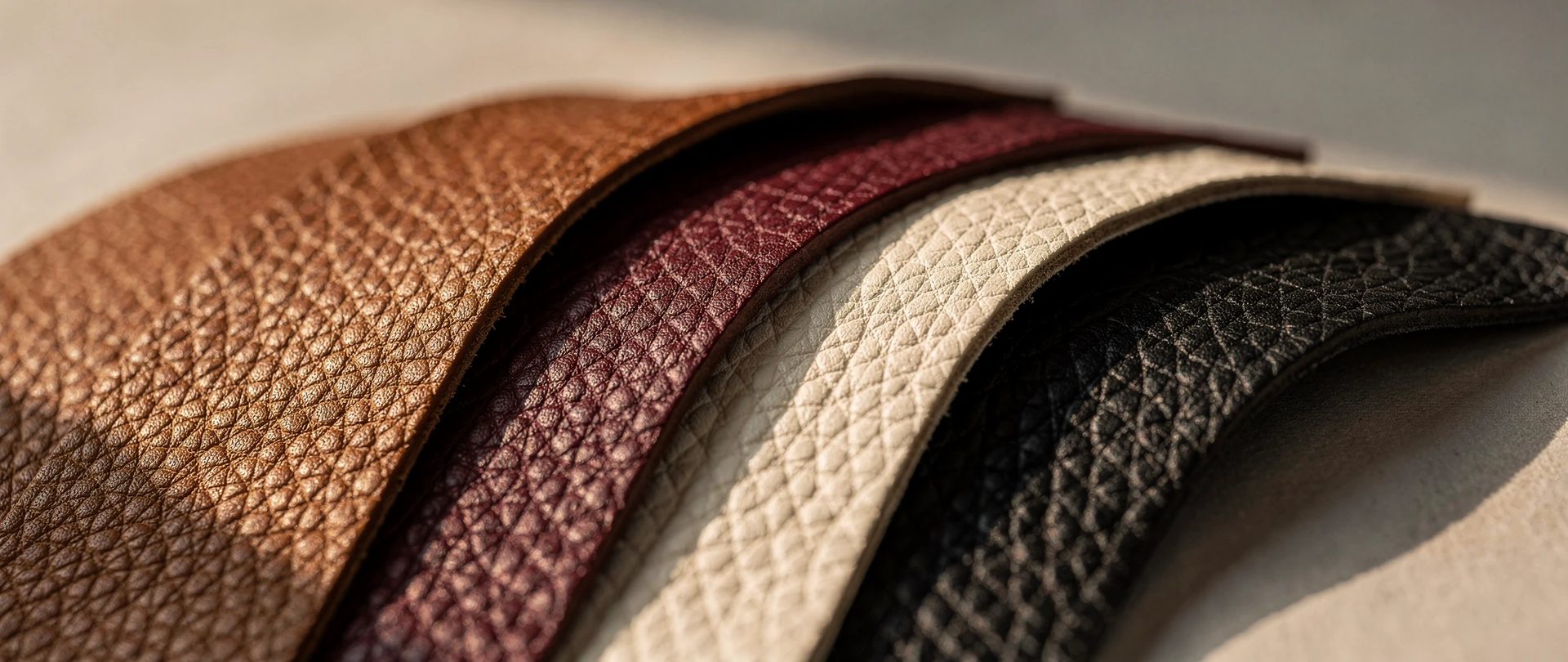
The colour of your interior gets decided once. After that it is cut, sewn, and sitting in front of you every time you open the door, for the next fifteen or twenty years.
It is also the one decision in the project that cannot be walked back partway through. Leather is bought in whole hides, it is cut to a pattern, and a cut hide does not become a hide again. Choosing the leather colour for your car happens before the work, never during it.
Here is the sequence that ends in a decided colour, in the order it actually runs.
What rules a colour out for your car
Start by removing shades. Three questions empty half the pile of swatches.
How your car gets driven. A convertible out on summer weekends takes sun and dust straight onto the seating surfaces. A car that comes out six times a season for a show does not live the same life.
Who gets in it. A dog, kids, work clothes, dark new jeans: each leaves a different trace depending on the shade underneath them.
What stays in your car. The dashboard, the carpet, the headliner, the painted metal on the doors, the wood or the chrome. Leather is not chosen on its own, it is chosen against those pieces. If your dashboard stays black, a cream seat is a two-tone decision and has to be made as one.
What survives those three questions usually fits in one hand. That is where the real choice starts.
Look at the sample in your car, in daylight
A swatch judged under a shop fluorescent or a garage bulb lies. Artificial light pulls browns toward grey and makes a beige look cleaner than it will ever be.
Take the sample outside into daylight, then put it in your car, on the seat, and look at it from the angle and the distance you actually sit at.
Look at it flat, then folded. Grain and pleats make shadow, and a pleated panel always reads darker than the flat piece. If your interior is pleated, the folded sample is the one telling the truth.
Ask for the biggest piece the supplier is willing to hand over. A four-inch chip does not allow an honest decision.
And look at it twice, on two different days, once in the morning and once late in the afternoon. A shade that holds under two lights will hold under the rest.
What changes between a swatch and a whole interior
A piece of leather and a finished interior are not the same colour. It is the most common surprise, and it always arrives at the same moment, on delivery.
Volume darkens. Three square metres of the same hide read heavier and more saturated than the chip did. A mid shade becomes dark, a dark shade becomes deep.
The orientation of the surfaces splits the colour apart. Your seat cushions take light from above, your door panels take it from the side, so the same hide gives two different shades inside the same car. That is normal, and it is why the decision gets made on the whole interior.
Contrast stitching is a second colour decision, taken at the same time. White thread on a black hide is a graphic line you will see from outside the car with the windows down. Piping and perforation do the same thing: a perforated insert reads lighter than a solid panel, because the holes let the backing show through.
Beige, black, bordeaux: what each family will show you
No shade is better than another. Each one shows you something different, and the work is choosing what you are willing to see.
Beige and cream make use readable. Transfer from dark denim shows on the cushion and on the driver's bolster before anywhere else. In exchange they keep the cabin bright and they run cooler in the sun.
White is the least forgiving colour there is. It works on a car that is driven little and brought out to be looked at.
Black hides marks and shows everything else: dust, hair, and every scuff turning up as a lighter line. It is also the shade that climbs highest in temperature in a car parked through July.
Mid shades carrying brown or red in them forgive the most. Chestnut, tobacco, and bordeaux leather, that dark red leaning brown which turns up so often in older interiors, hide marking without underlining scratches the way black does. If you are torn between showing use and showing scratches, this is the family that splits the difference.
Bright red is more present in a car than it is on the swatch. On a clear day it throws its own colour back into the windshield reflection. That is not a fault, it is an effect worth having seen before ordering it.
Original or free: two routes for your classic car
On most North American cars of the era, the interior colour that left the factory is recorded as a code on the car's data plate. A restoration shop or the model's club can read it. That is your starting point if you want to stay faithful to the original.
One thing is worth saying plainly at this point. Plenty of 1960s and 1970s interiors mixed vinyl bolsters with fabric or vinyl inserts. An all-leather interior in a period shade is already, by itself, a custom interior. There is nothing wrong with that, but it is better known before anyone says "faithful to the original".
The other route is choosing freely. It is just as valid, provided it is decided before the cutting and not discovered at the fitting. Annie works on any classic car, faithful to the original or custom to your own vision, and both ask for the same thing: a settled colour.
Knowing which of the two routes you are on decides what your sample gets compared against.
What makes your decision firm enough to cut
A colour is decided once it has passed five tests. Seen in daylight. Seen in your car, on the seat, at your angle. Seen flat and folded. Seen next to the pieces that are staying. Seen on two different days.
One more, less technical: one person calls it. A colour chosen by two voices reopens on delivery, and delivery is too late.
The rest is ordinary trade. Hides vary from lot to lot, so the quantity for your whole interior is ordered at once, out of the same lot, because two lots carrying the same colour reference do not always agree. Some shades are not held in stock and have to be ordered in, and a supplier who keeps a colour in small quantity sets his own calendar. The usual wait before a new project starts is four weeks and up, depending on the season.
Once the pattern is marked out and the first piece is cut, the colour is settled. That is why it gets decided beforehand.
What the material does after that, its grain, its thickness and how it behaves in a Quebec cabin, is covered on the leather page. How a full interior is remade from end to end is on the classic car interior restoration page.
Samples get looked at on your car, in your garage, before a single piece is cut. Custom upholstery and trim, workshop by appointment, Montreal's Rive-Nord, with travel out to Laval, the Laurentides and Lanaudière. The conversation and the work happen in French.
Frequently asked questions
- Does beige leather in a car really show every mark?
- It shows marking more plainly, which is not the same thing as being dirty. Transfer from dark new denim reads immediately on a light seating surface, and the driver's side bolster is always the first area to go. On a dark hide the same transfer happens and stays invisible. Choosing beige means accepting that how your car gets used stays readable on the seating surfaces.
- Which leather colour heats up least in a car parked in the sun?
- A light shade sends part of the light back, a dark one absorbs it and gives it off as heat. A black interior parked through a July afternoon therefore gets hotter to the touch than a cream or tobacco one, with the same glass and the same ventilation. Perforated inserts and the shade of a roof matter as much as the colour does, so weigh all three together.
- Should a classic car keep its original interior colour?
- Both routes are valid, and both are decided before anything is cut. On most North American cars of the era the factory interior colour is recorded as a code on the car's data plate, and a restoration shop or the model's club can read it. Start from that code and everything gets compared to it. Choose freely instead and your interior becomes a custom one, compared to your paint, your dashboard and your carpet.
Related reading
- Leather or fabric for a classic car interior
Leather or fabric for a classic car interior. What each material actually holds up to, piece by piece, and how the choice gets made before anything is cut.
- 1965-1968 Mustang interior: what to remake, what to buy
A 1965-1968 Mustang interior is unusually well served by the reproduction catalogue. Here is what it covers properly, and the parts worth having made.
- Upholstery, rembourrage, classic car trim in Quebec
Sellerie, rembourrage, garniture or classic car trim: what each word actually means in Quebec. Which one to use when you call a shop on the North Shore.