Materials
What a Quebec winter does to leather, vinyl and canvas
· 5 min read · Atelier Annie Dallaire
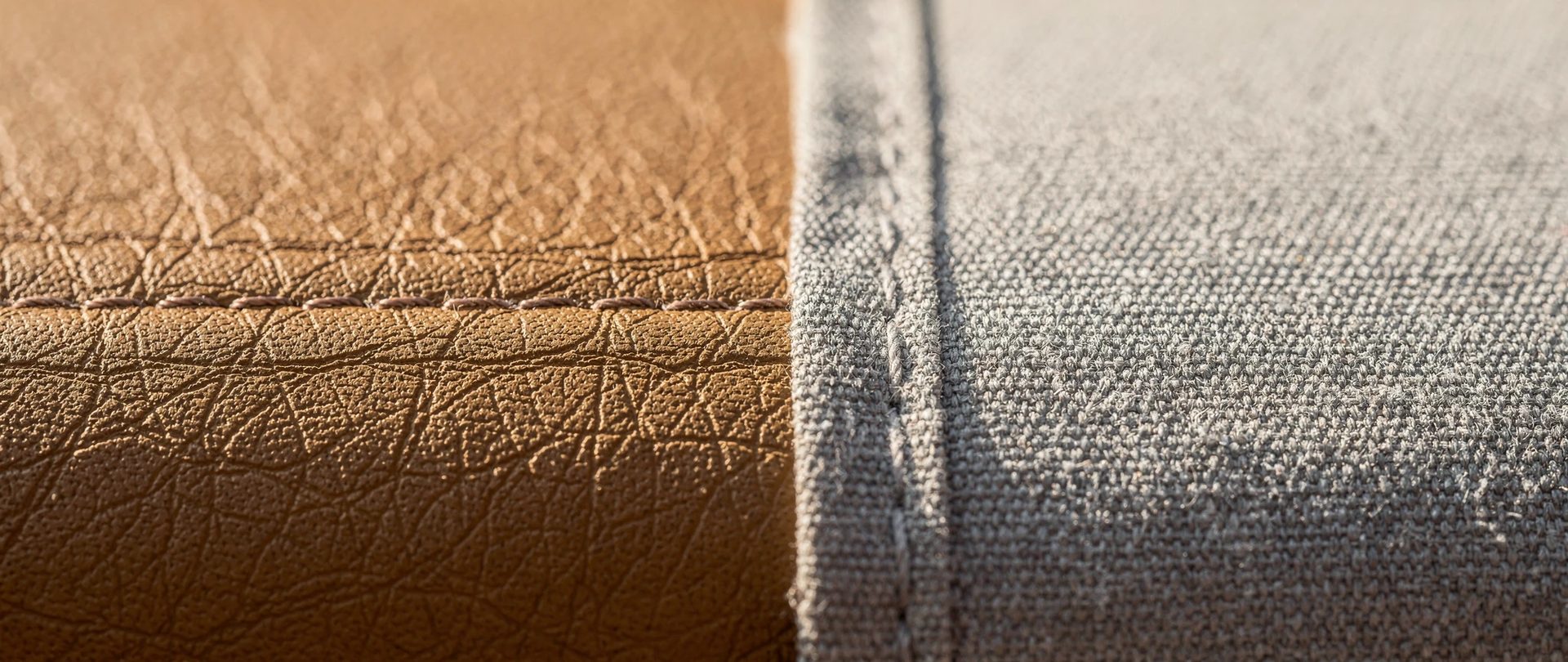
A leather seat does not crack because it is cold. It cracks because it is dry, and because someone sits on it while it is stiff.
That distinction matters, because it changes what you should actually do before November. And because the answer is not the same for your car as it is for your boat.
Most care guides are written by shops that only touch one of the two. An owner with a bowrider at the dock and a Camaro in the garage ends up holding two lists of advice that contradict each other, and both lists are right, for different materials.
Your car's leather: dry air is the real threat
Leather is a fibrous material that holds water and oils. The warm, dry air of a heated garage or an indoor parking level pulls both out of the fibre.
The Canadian Conservation Institute puts it plainly in its guidelines for collections: low relative humidity makes leather less flexible and more vulnerable to mechanical damage. Forced-air heating routinely drops indoor humidity below 30 percent for months at a time in Quebec.
Cold on its own stiffens the fibre without emptying it. The damage happens when the two combine. A dry fibre turns brittle, a brittle fibre splits when it is flexed, and it gets flexed every time someone slides over the edge of the seat.
That is why wear always concentrates in the same places. The outer bolster on the driver's side, the armrest, the lower back of the seat. Those are the points a body passes over. The centre of the cushion stays fine for years.
Feeding the leather before the heating season puts oils back into the fibre while it can still take them up. This is not cosmetic. It is what keeps your seats supple through the months that ask the most of them.
What that means for your car: a gentle clean, then a conditioner suited to finished automotive leather, in October or November. A second application around January or February, once the heat has been running for three months. Technical guidance converges on three to six month intervals in normal use, tightening to two or three months when indoor humidity sits below 40 percent.
Trust your hand over the calendar. Leather that starts to feel firm under the fingers tells you before the fine lines show up.
Your boat's vinyl and canvas: no oil, ever
Here, the instinct we just described is the wrong one.
Marine vinyl and solution-dyed acrylic canvas are synthetics. They contain no oil and no bound water. There is nothing to feed. An oily product sitting on top does not penetrate. It stays on the surface, collects dust, and can dry the vinyl out.
No marine fabric maker recommends conditioning its cloth. Their instructions come down to three actions: rinse the salt, dry it completely, store it without a tight fold.
Cold, though, works on synthetics much as it does on leather. Frozen vinyl turns rigid and splits if it is handled. Canvas folded on a sharp crease at minus twenty keeps the mark, and that crease becomes the start of a tear the following season.
What that means for your boat: wash it, rinse the salt, let it dry through before storage. Canvas stored damp will mildew, and mildew on solution-dyed acrylic never fully comes out. Store it flat or rolled, somewhere dry and ventilated, never compressed into a sealed bag.
And avoid handling panels while they are frozen. That is the move that costs the most, because nothing looks wrong at the time.
The detail on all three materials lives on the automotive and marine leather, marine vinyl and Sunbrella canvas pages, gathered under materials. Annie works with a network of suppliers and picks the material to suit the project, so those pages describe families of cloth from several suppliers.
Salt: the one shared enemy
Road salt is where both of your vehicles suffer from the same thing.
When salt water soaks into a material, the water eventually evaporates. The crystals stay. And they keep drawing moisture, indefinitely, until someone removes them. On leather that means a fibre drying from the inside. On vinyl and canvas it means a deposit holding water against the material.
Salt also works as an abrasive. Mixed with the fine grit that falls off boots, it polishes leather a little with every entry and exit. A seat that has gone glossy where the finish should stay matte is almost always that.
The useful action is unremarkable: wipe visible salt while it is still there. Not next month.
When care no longer catches up
There is a point where feeding the leather changes nothing. The fibre has lost its suppleness deep down, the splits run through the finish coat, and the product only puts a shine on a surface that is already gone.
Past that point it is no longer a maintenance question. It is a question of making a new cover.
That is Annie's work: leather seats cut and sewn to your car's own dimensions, faithful to the original or built to your vision. Same on the marine side, where the benches and cushions in your boat are rebuilt completely, new cover over new foam. An interior redone that way starts a fresh run of years, in a material chosen for the use you actually give it.
Real lead time runs four to eight weeks depending on the season, and some materials have to be ordered in. It is patient work, done by hand, in a workshop on Montreal's Rive-Nord.
If your seats are at that stage, the custom leather seats page walks through how it goes, from measuring to installation. These pages read in English and are meant to; the call, the quote and the work itself happen in French, which is the only language Annie works in.
The short calendar
For your car, before the heat comes on: clean, feed the leather, do it again mid-winter.
For your boat, before storage: wash, rinse the salt, dry it through, store it without a tight fold and without damp.
Two materials, two opposite logics, the same winter. That is the whole of it.
Related reading
- Leather or fabric for a classic car interior
Leather or fabric for a classic car interior. What each material actually holds up to, piece by piece, and how the choice gets made before anything is cut.
- Choosing the leather colour for your car interior
Choosing the leather colour for your car interior before anything is cut. What rules a shade out, what a swatch hides, and what makes the decision final.
- Why marine vinyl cracks, and what it says about the foam
Marine vinyl that cracks dried out long before the first split. Once the split is open, the foam underneath decides what happens next.