Classic cars
Recolour or remake your classic car interior
· 8 min read · Atelier Annie Dallaire
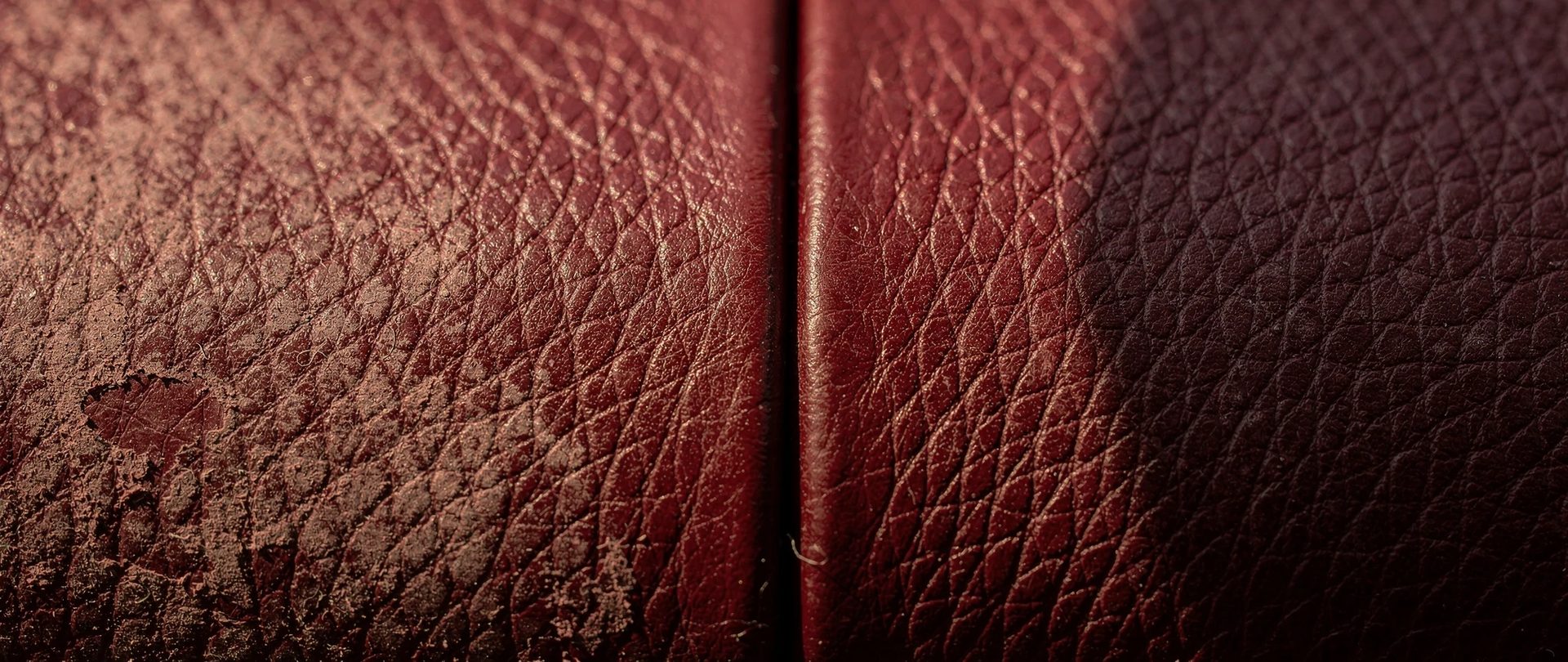
Search for classic car interior restoration around Montreal and you will land on the same offer almost every time. Someone comes to you, cleans, recolours, and your seat looks new by the end of the day.
That is not a hard sell. On a good share of cars it is exactly the right move, and further down you will find the cases where it is.
What nobody explains is where the line sits. At what point colour stops being enough, and why your seat goes ugly again six months later even when the work was done well.
What dye gives your seats, and for how long
Automotive leather is finished leather. Over the fibre sits a pigment layer and a flexible topcoat that carry the colour and take the rubbing.
Recolouring rebuilds that layer. The product lands on the existing finish. It does not go down into the fibre.
As long as the fibre underneath still bends without breaking, the new layer bends with it and it holds. Your seat gets its shade back and runs for years.
Once the fibre has turned brittle, that same layer lands on leather that moves and splits. It fills the cracks for a while, then reopens in exactly the same places, because nothing underneath has changed.
That is why two cars treated the same week with the same product age differently. The state of the fibre under the product decides that.
Your cracked leather: surface wear or finished fibre
There is a test you can run yourself, in your own garage, without buying anything.
Take the leather between two fingers at the worst spot and fold it gently.
Leather with only the finish worn out stays supple. The crazing is fine and even, and it does not move when you fold. The material is still doing its job.
Leather with finished fibre hardens under the fingers. The splits open at the fold and show a paler colour underneath. The surface sometimes crumbles a little under a fingernail.
The second case does not come back. No product returns suppleness to a fibre that has lost it deep down.
One detail that saves a lot of surprises: on many cars from the sixties and seventies, what you take for leather is factory vinyl. Aged vinyl does not behave like leather. It hardens, it splits along the seams, and it gets replaced.
Leather gone tacky or shedding: the finish is done
The finish lets go in two other ways.
It turns sticky. The flexible topcoat breaks down under years of trapped heat and goes gummy under the hand. A conditioner leaves the same feel: on finished leather it has nowhere to go. It sits on top and collects dust.
It sheds. The pigment lifts off the hide in flakes at the driver's side bolster, the front edge of the cushion, the armrest. What rubs goes first: a finish that is done lets go in zones, a finished fibre hardens across the whole panel. Then lift a loose flake at its edge. If the colour changes underneath and the material still bends, the leather is alive under a dead finish.
Liquid leather sold in a kit is a pigmented flexible paste that fills the hollow and recolours over a layer already letting go. The hollow reopens in the same place, raised this time.
A finish at that stage is the normal end of a recolour, even a good one. What follows is on the custom leather seats page.
Classic car interior restoration: what your car actually gets
Remaking an interior is not one thing. It is a pattern, a material, and a decision about what your car should become again.
Faithful to the original: the pattern is lifted from the covers on the car, the same stitch lines and the same number of pleats are kept, and the material is chosen to come as close as possible to the factory grain. That is the road for cars you bring to a classic car meet.
Custom to your own vision: same dimensions, same fit, but the material, the colour, the stitch pattern and the embroidery are yours. That is the road for cars you drive.
Annie does both, on any classic car model, faithful to the original or custom to your vision. The choice is yours. Either way the pattern comes off your own car.
Under your seat cover: foam, frame, webbing
A new cover takes the shape of whatever sits under it. That is the part nobody sees, and it is the part that decides how long the work lasts.
The original polyurethane foam is fifty years old or more. It oxidises, it loses its rebound, and it eventually crumbles when handled. Foam at that stage does not come back because new leather went over it.
The webbing and the springs in the cushion slacken over decades. A seat that leaves you sitting lower than it used to, or leaning to one side, is telling you that and nothing else.
When a seat is remade completely, the new cover goes over new foam cut to the right density, for support that holds up season after season. That is the difference between a seat that looks new and a seat that is.
It is also why a remade interior does not get settled in a day. Real lead time runs about four to eight weeks depending on the season, and some materials have to be ordered in, sometimes from a supplier who stocks them in small quantity. It also happens that a seat needs an adjustment once you have used it for a few weeks. That is part of the work.
Mould, and a cover gone slack: two signs that are not the leather
Mould needs water and still air. In a car it follows a water entry: a window seal, a door membrane, a sunroof drain. A winter shut up in storage does the rest. On a sound finish it blooms on the surface. When it comes back in the same spot and the smell stays, it is in the foam. Nothing on the surface reaches it, and a new cover over damp foam starts the same thing again.
A cover gone slack or deformed is another case. It is fitted under tension over its foam. Push the wrinkle flat with your hand. If it disappears and the leather is still supple, the volume underneath has gone, or the ties in the hollow of the seat have let go.
The grains and the weights are on the automotive and marine leather page.
When recolouring is the right call for your car
Here are the cases where colour is the right answer, and where remaking your interior would be money in the wrong place.
Your leather is faded but supple. The shade has gone in the sun, the grain is intact, the material folds without splitting. A clean recolour will buy you years.
One panel is gone. The headrest or the driver's side bolster has lost its shade while the rest is sound. Remaking the whole interior for one panel makes no sense.
You are selling the car soon. A new interior does not always come back in the sale price. A tidy recolour does.
Your budget is tight and the fibre is still good. Recolour now, remake later, is an honest plan. The fibre does not degrade faster because it has been dyed.
In those four cases, Annie is not the person to call. A recolouring shop is, and there are good ones in Laval and on Montreal's Rive-Nord.
What Annie does starts where colour stops being enough. When the fibre is finished, when the foam has collapsed, when the factory vinyl is splitting along the seams, or when you want an interior that never existed at the factory.
The detail of the work is on the classic car interior restoration page, and the leather side on the custom leather seats page. The material itself, its grains and its weights, is set out on the automotive and marine leather page. Annie works with a network of suppliers and picks the material to suit the project, so those pages describe families of material from several suppliers.
Measuring happens in your garage, on your car, before a single piece is cut. Custom upholstery and trim, workshop by appointment, Montreal's Rive-Nord, with travel out to Laval, the Laurentides and Lanaudière. That visit runs in French, like the quote and everything after it, so an owner who reads this in English and speaks French is on the right page.
Frequently asked questions
- Does recolouring automotive leather damage the material?
- No. A recolouring product sits on the finish rather than in the fibre, and it does not speed up the ageing of the leather underneath. What it does not do is return suppleness to a fibre that has already turned brittle. If your leather hardens under the fingers and the splits open when you fold it, fresh colour will not hold for long.
- How do I know if the foam in my seats is finished?
- Sit down and compare the height against the passenger seat, which has almost always seen less use. Visible sag, a lean to one side, or the feeling of dropping toward the frame all point to foam and webbing that are at the end. A new cover laid over that will take the same hollow shape within weeks.
- Can an interior be remade exactly like the original?
- In most cases, yes. The pattern is lifted from the covers on the car, the stitch lines and the pleat count are reproduced, and the material is chosen to come as close as possible to the factory grain and shade. When an original cloth no longer exists, you are shown the nearest options before anything is cut.
Related reading
- Leather or fabric for a classic car interior
Leather or fabric for a classic car interior. What each material actually holds up to, piece by piece, and how the choice gets made before anything is cut.
- 1965-1968 Mustang interior: what to remake, what to buy
A 1965-1968 Mustang interior is unusually well served by the reproduction catalogue. Here is what it covers properly, and the parts worth having made.
- Classic car headliner and door panels
A classic car headliner and its door panels fail differently from the seats. Here is what goes wrong behind each one, and what decides recover against remake.